ACAS Early Conciliation: How It Works, Step by Step
This guide covers England and Wales. It is general information, not legal advice, and is not a substitute for advice about your own situation. Laws and figures change - always check the current position on GOV.UK before relying on any detail here.
Notify ACAS
Pauses your deadlineFill in the notification form on the ACAS website or call 0300 123 1122, giving your details, the employer's full legal name and a short plain description of the dispute. The clock on your tribunal deadline pauses the moment you notify.
ACAS contacts your employer
Within days of notifyingA neutral conciliator explains the process to the employer and checks whether both parties want to try to resolve the dispute. The employer is not obliged to engage.
Negotiate through the conciliator
Up to about 12 weeksIf both sides are willing, the conciliator helps explore an agreement - a financial settlement, an agreed reference, an apology or changes to practices. A binding agreement is recorded on a COT3 form.
Receive the certificate if no settlement
At the end of conciliationIf conciliation does not settle the dispute, ACAS issues an Early Conciliation certificate with a unique reference number, which is required to file the ET1 claim form.
What is ACAS Early Conciliation?
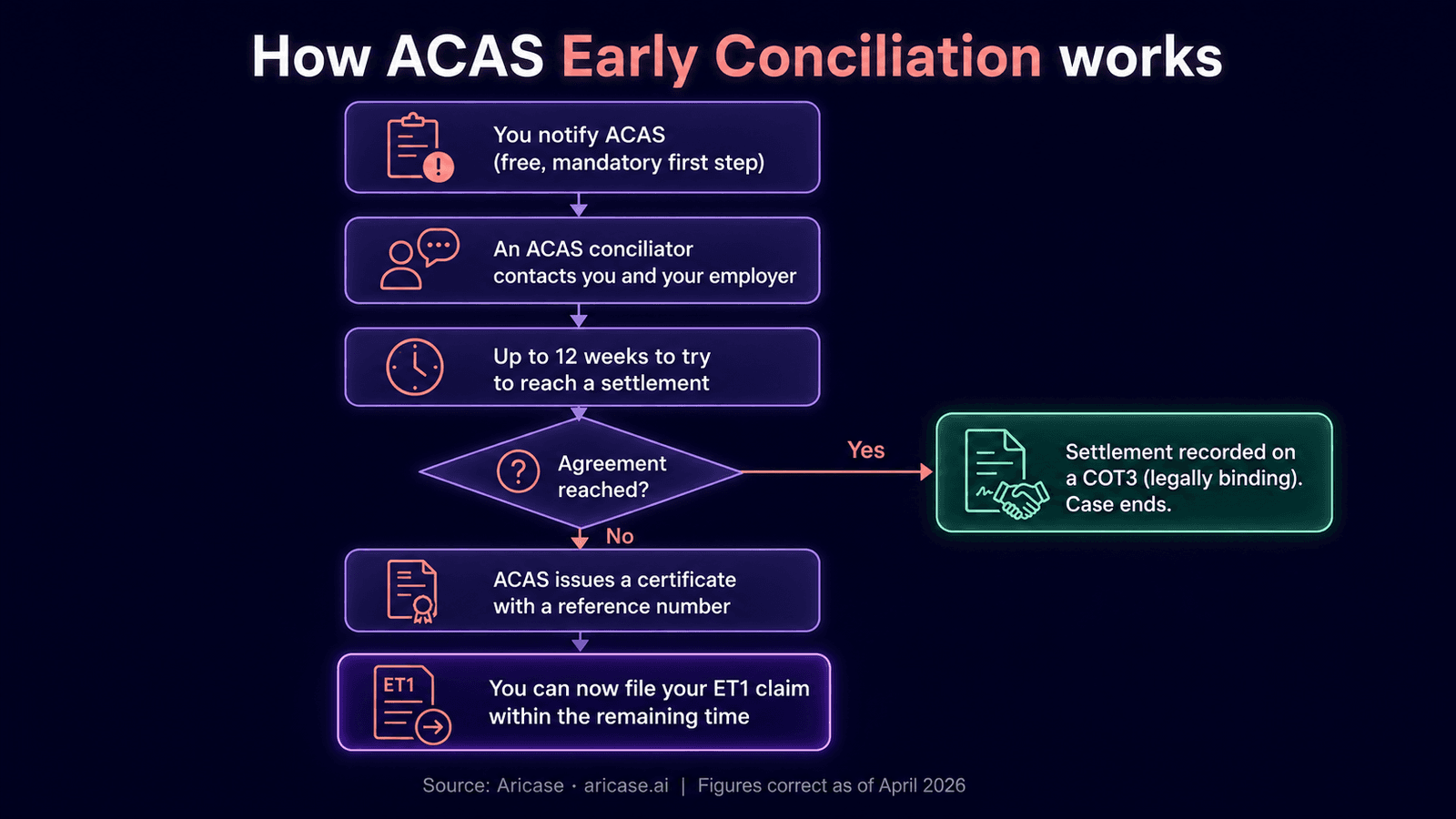
Before you can take a claim to an employment tribunal, you are legally required to go through ACAS Early Conciliation - a free, confidential service designed to see if your dispute can be resolved without a formal hearing.
ACAS (the Advisory, Conciliation and Arbitration Service) is an independent body. Early Conciliation is mandatory under section 18A of the Employment Tribunals Act 1996 and the certificate it produces is what unlocks your right to file an ET1 claim form.
Early Conciliation usually comes after you have tried to resolve the problem internally. For the full sequence of steps before a claim - from raising it informally through to this stage - see our guide on what to do before making a tribunal claim.
Step 1: Notify ACAS
Start by filling in the notification form on the ACAS website or calling 0300 123 1122. It is a short online wizard with five steps:
- Choose whether to take part in early conciliation, or get a certificate straight away to go to tribunal. Both options use the same form.
- Your details - full name, phone number, address.
- Representative's details (optional) - only if a trade union rep, solicitor, friend or family member is acting for you. If you fill this in, ACAS will contact them instead of you.
- Who the claim is against - the full legal name of your employer (use the proper form, for example "ABC Limited" rather than "ABC"). Getting this exactly right matters because a later mismatch between the certificate and your ET1 claim form can lead to the tribunal rejecting it.
- Reasons for the dispute - a short, plain description of what happened. ACAS asks you to "tell us as much information as you can" so the conciliator can have a useful first conversation. Cover the main issue (for example, unfair dismissal, discrimination, unpaid wages), key dates (when the problem started, when you were dismissed, when you raised a grievance), and who was involved. Leave the legal argument and remedy figures for the ET1 itself.
- Check and submit - review your answers and send.
Important: the moment you notify ACAS, the clock on your tribunal deadline pauses. Do not delay - contacting ACAS early gives you the maximum runway.
Step 2: ACAS contacts your employer
A conciliator reaches out to your employer to explain the process. The conciliator is neutral - they do not take sides, and they do not give legal advice. They check whether both parties want to try to resolve the dispute.
Your employer is not obliged to engage. Many do, because defending a tribunal claim is expensive and time-consuming even when the employer wins.
Step 3: Negotiation
If both sides are willing, the conciliator helps you explore what an agreement might look like. Typical outcomes include:
- A financial settlement
- An agreed reference
- An apology or acknowledgement
- Specific changes to the employer's practices
Any binding agreement reached through ACAS is recorded on a COT3 form. Once signed, the COT3 is legally enforceable and you usually waive the right to bring tribunal claims about the matters covered. Make sure you understand the full scope before signing. See ACAS guidance on how conciliation works.
Step 4: The certificate
If conciliation does not result in a settlement, ACAS issues an Early Conciliation certificate with a unique reference number. You need that reference number to file your ET1 claim form.
The process can run for up to about 12 weeks for cases notified on or after 1 December 2025 (the older 6-week period applies to earlier notifications). It can be extended by 14 days if both sides agree. After that, the certificate is issued regardless.
How Early Conciliation affects your tribunal deadline
Once you have the certificate, you have either:
- The remaining time left on your original 3-months-less-1-day deadline, or
- One month from the certificate date - whichever is longer
See our tribunal deadlines guide for worked examples and the rules on the trigger date.
Key things to know
- It is free - there is no charge for the service.
- It is confidential - discussions during conciliation cannot be used as evidence at tribunal.
- It pauses the clock - time spent in conciliation does not count toward your 3-month window.
- You can still go to tribunal - if no agreement is reached, you keep your right to file.
- You do not need a solicitor - many people go through Early Conciliation without legal representation. See our self-representation guide if you are weighing it up.
What happens after Early Conciliation?
If you settle, the COT3 is the end of the dispute (for the matters it covers). If you do not, the next step is your ET1 claim form. The certificate reference number is the link between the two.
Sources used in this guide
- ACAS: Early Conciliation
- ACAS: How conciliation works
- Employment Tribunals Act 1996 - Section 18A
- GOV.UK: Make a claim to an employment tribunal
Links to legislation.gov.uk, gov.uk, acas.org.uk and bills.parliament.uk are official sources. Always check the current version on the source site before relying on a specific point.
Frequently asked questions
Is ACAS Early Conciliation compulsory?
Yes for almost every employment tribunal claim. Section 18A of the Employment Tribunals Act 1996 requires you to notify ACAS before issuing a claim, and you cannot file an ET1 without an ACAS certificate reference number.
What is a COT3?
A COT3 is the legally binding settlement form used when you and your employer reach agreement through ACAS. Once you sign, you usually give up the right to bring tribunal claims about the matters it covers - so understand exactly what you are agreeing to.
Does my employer have to take part?
No. Participation is voluntary. If your employer declines or does not engage, ACAS issues the certificate so you can proceed to tribunal. Most employers do engage because settling is usually cheaper than defending a claim.
How long does Early Conciliation take?
Up to about 12 weeks for cases notified to ACAS on or after 1 December 2025 (the older 6-week period applies to earlier notifications). You can end the process sooner if both sides agree there is nothing to discuss.
Not sure where you stand?
Build your case with Ari and get a human expert check - free for the first 7 days, cancel anytime.
Start your 7-day free trialOr use the free Employment tribunal deadline calculator.
Related guides
 Deadlines9 min read
Employment Tribunal Time Limits: 3 Months Less 1 Day, Explained
How UK employment tribunal time limits work - the 3 months less 1 day rule, trigger dates by claim type, how ACAS pauses the clock, and late claims.
Read guide Documents10 min read
How to Fill In Your ET1 Employment Tribunal Claim Form
How to fill in the ET1 claim form, section by section: the respondent, the claim narrative, the remedy section, and the mistakes that sink cases.
Read guide Negotiation7 min read
Settlement Agreements: Should You Accept, Negotiate or Reject?
How UK settlement agreements work, what to negotiate first, which elements are tax-free, red flags to watch for before signing, and when to reject the offer.
Read guide