Employment Tribunal Time Limits: 3 Months Less 1 Day, Explained
This guide covers England and Wales. It is general information, not legal advice, and is not a substitute for advice about your own situation. Laws and figures change - always check the current position on GOV.UK before relying on any detail here.
Employment tribunal claims have some of the strictest deadlines in the civil justice system. For most claims the employment tribunal time limit is 3 months less 1 day from the event you are complaining about - and in practice, missing it almost always bars the claim, no matter how strong the underlying facts. This guide explains the rule claim by claim, exactly when the clock starts, how ACAS pauses it, and the narrow discretions tribunals have to accept a late claim.
If you want your own dates worked out rather than the rules in the abstract, our free tribunal deadline calculator does the arithmetic for you: enter your trigger date and it shows your ACAS notification deadline and your post-certificate filing window.
The clock keeps running while you are still trying to resolve the problem internally, which catches many people out. If you are at that earlier stage, our guide on what to do before making a tribunal claim explains how the grievance, appeal and ACAS steps fit around the deadline.
Law status - last updated 29 June 2026: The current time limit is 3 months less 1 day for most claims. The Employment Rights Act 2025 is expected to extend it to 6 months (targeted October 2026, with breach of contract staying at 3 months), but that change is not yet in force and depends on commencement regulations - work to the 3-month rule until then.
The general rule: 3 months less 1 day
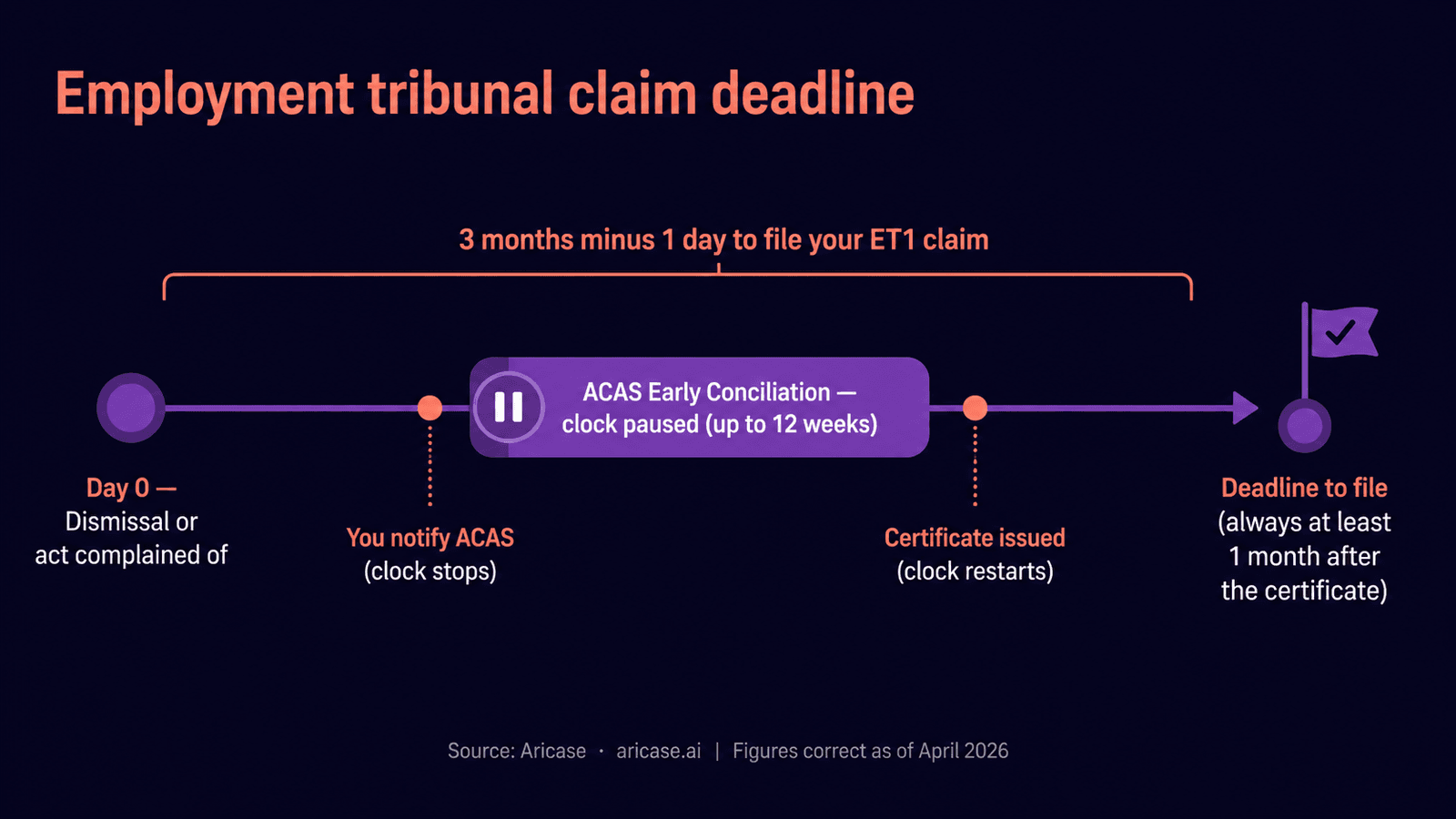
For most employment tribunal claims, two things must happen in time:
- You must notify ACAS to start Early Conciliation within 3 months less 1 day of the trigger event. The duty to notify ACAS before bringing a claim is set out in section 18A of the Employment Tribunals Act 1996.
- After ACAS issues your certificate, you must file your ET1 claim form within the post-certificate window explained below.
"3 months less 1 day" is exact. If your last day of work was 15 January, your deadline to contact ACAS is 14 April - not 15 April. For unfair dismissal the time limit comes from section 111 of the Employment Rights Act 1996; for discrimination, from section 123 of the Equality Act 2010.
A small number of claims have different limits. The table below sets out the main ones.
When does the clock start?
The time limit is only half the question. The other half is the trigger date - the day the clock starts running. It varies by claim type (see the GOV.UK guidance on time limits):
| Claim type | Time limit | When the clock starts |
|---|---|---|
| Unfair dismissal | 3 months less 1 day | The effective date of termination |
| Discrimination | 3 months less 1 day | The act complained of, or the last act in a continuing series |
| Unlawful deduction from wages | 3 months less 1 day | The date of the last deduction in a series |
| Whistleblowing detriment | 3 months less 1 day | The date of the detrimental act |
| Breach of contract (in the tribunal) | 3 months less 1 day | The date employment ends |
| Statutory redundancy payment | 6 months | The date employment ends |
| Equal pay | 6 months | The end of the employment |
Three trigger dates cause most of the confusion in practice.
Unfair dismissal: the effective date of termination. This is usually your last day of employment. If you worked your notice, it is the day the notice period expired. If you were dismissed without notice and paid in lieu, it is normally the day you were actually dismissed - not the day a paid-in-lieu period would have run to. If the date is ambiguous, take the earliest plausible date and calculate from that.
Discrimination: the act, or the last act in a continuing series. Section 123 of the Equality Act 2010 treats "conduct extending over a period" as done at the end of that period. So if you faced a connected course of discriminatory treatment, the clock runs from the last act in the series. But whether conduct really was "continuing" is decided by the tribunal after the event, and isolated incidents months apart may not qualify. The safer approach is to calculate from the first incident you want to complain about, not the last.
Unpaid wages: the last deduction in a series. For unlawful deductions from wages, the clock runs from the date of the last deduction in a series of linked deductions - which matters where the underpayment happened month after month.
How does ACAS pause the clock?
You cannot file an ET1 without an ACAS Early Conciliation certificate. The good news is that notifying ACAS pauses the deadline clock. Two dates matter:
- Day A - the day you notify ACAS to start Early Conciliation
- Day B - the day ACAS issues your certificate
The time between Day A and Day B does not count towards your deadline. Conciliation can run for up to 12 weeks (for notifications made on or after 1 December 2025), extendable by a further 14 days if both sides agree. After Day B you get whichever is longer:
- the time you had left on the original deadline when you notified ACAS, or
- 1 month from the certificate date.
A worked example
Say you were dismissed on 10 March.
- The original deadline. 3 months less 1 day from 10 March is 9 June. You must notify ACAS by that date.
- You notify ACAS on 20 April (Day A). At that point you have 50 days left on the clock - 20 April to 9 June.
- ACAS issues your certificate on 15 May (Day B). The 25 days of conciliation did not count against you.
- The clock restarts with your 50 days intact. 50 days from 15 May takes you to 4 July.
- The 1-month-minimum check. One month from the certificate would be 15 June. You get whichever is longer - so 4 July is your ET1 filing deadline.
The one-month minimum exists to protect people who notify ACAS very close to the deadline: even if you had only 2 days left on the clock at Day A, you still get a full month from the certificate to file. The statutory counting rules have technical edge cases, so treat any manual calculation as provisional - the tribunal deadline calculator applies the rules for you, and the tribunal's own decision on the dates is final.
For what actually happens during conciliation - what to tell ACAS, how settlement discussions work, what the certificate looks like - see the ACAS Early Conciliation guide.
What if you miss the deadline?
Treat the deadline as hard. In practice, missing it almost always bars the claim. Tribunals do have a discretion to accept late claims, but the tests are strict and the starting point is always that the limit applies.
"Not reasonably practicable" - unfair dismissal and most other claims. Under section 111 of the Employment Rights Act 1996, the tribunal can accept a late unfair dismissal claim only if it was not reasonably practicable to bring it in time, and it was then brought within a reasonable further period. This is a strict test. "I did not know about the time limit", "I was waiting for my internal appeal", or "I was hoping to settle" almost never succeed. Serious incapacitating illness, or being actively misled about a fact essential to the claim, occasionally can.
"Just and equitable" - discrimination claims. Under section 123 of the Equality Act 2010, the tribunal can extend time where it considers it just and equitable to do so. This is broader than the unfair dismissal test and gives the tribunal a genuine discretion - but extensions remain the exception, not the rule, and a tribunal is entitled to refuse one even where the delay was short and the claim looked strong.
Either way, the practical rule is the same: do not plan around the discretion. If the deadline has not yet passed, contacting ACAS today is worth more than any extension argument you could make later.
Is the time limit changing to 6 months?
Probably - but not yet. The Employment Rights Act 2025 extends the standard employment tribunal time limit from 3 months to 6 months for most claims. The change is currently targeted for October 2026, but it is not yet in force and depends on commencement regulations. Two cautions:
- Until commencement, the 3 months less 1 day rule applies. Check the current position before relying on the longer limit.
- Breach of contract claims in the tribunal are expected to stay at 3 months even after the change.
See the Employment Rights Act 2025 guide for the wider package of reforms and their expected timing.
Protecting your deadline
- Contact ACAS as soon as you think you might have a claim. It is free, it is confidential, and notifying pauses the clock - you do not need to have decided anything first.
- Do not wait for a grievance or internal appeal to finish. Internal processes do not stop the tribunal clock.
- Keep dated records of the key events: your last working day, the dismissal letter, each discriminatory act, the dates payments were due.
- Calculate carefully, then check. Work out your trigger date, apply 3 months less 1 day, and run the dates through the deadline calculator rather than trusting mental arithmetic.
The single most common way people lose the right to bring a tribunal claim is the calendar, not the merits. If the clock is ticking, your priority is ACAS - everything else (drafting the ET1, gathering evidence, working out what your claim is worth) can come after.
Sources used in this guide
- GOV.UK: When you can claim - time limits
- ACAS: How Early Conciliation works
- Employment Tribunals Act 1996 - Section 18A
- Employment Rights Act 1996 - Section 111
- Equality Act 2010 - Section 123
- Equality Act 2010
- Employment Rights Act 2025
- GOV.UK: Redundancy - your rights
Links to legislation.gov.uk, gov.uk, acas.org.uk and bills.parliament.uk are official sources. Always check the current version on the source site before relying on a specific point.
Frequently asked questions
When does the 3-month clock start?
It depends on the claim. For unfair dismissal it starts on your effective date of termination - usually your last day of employment or the end of your notice period. For discrimination it starts on the date of the discriminatory act, or the last act in a continuing series of connected acts. For unpaid wages it starts on the date of the last deduction in the series.
Does ACAS Early Conciliation extend my deadline?
It pauses the clock. The time between the day you notify ACAS (Day A) and the day your certificate is issued (Day B) does not count. After the certificate you have either the time left on your original deadline or 1 month from the certificate date - whichever is longer. But you must contact ACAS before the original deadline expires.
What if I miss the deadline?
The tribunal can sometimes accept a late claim if it was 'not reasonably practicable' to file on time (for unfair dismissal and most claims) or if it is 'just and equitable' to extend (for discrimination). Both tests are difficult to meet, and in practice missing the deadline almost always bars the claim. The safest assumption is that the deadline is hard.
Does raising an internal grievance extend the deadline?
No. Internal grievance and appeal processes do not stop or extend the tribunal clock. If your grievance is still running, you still need to start ACAS Early Conciliation before the deadline expires.
Is the time limit changing to 6 months?
The Employment Rights Act 2025 extends the standard time limit from 3 months to 6 months for most claims, with the change currently targeted for October 2026 - but it is not yet in force and depends on commencement regulations. Breach of contract claims are expected to stay at 3 months even after the change. Until commencement, work to the 3 months less 1 day rule and check the current position before relying on the longer limit.
Not sure where you stand?
Build your case with Ari and get a human expert check - free for the first 7 days, cancel anytime.
Start your 7-day free trialOr use the free Employment tribunal deadline calculator.
Related guides
 Process9 min read
Employment Tribunal: How Claims Work in England and Wales
What an employment tribunal is, the claims it hears, how a case runs from ACAS to the final hearing, the deadlines and the compensation - a plain-English guide.
Read guide Process6 min read
ACAS Early Conciliation: How It Works, Step by Step
What ACAS Early Conciliation is, why it is mandatory before an employment tribunal claim, and what to expect at each stage of the process.
Read guide Claims11 min read
Unfair Dismissal in the UK: Do You Have a Claim?
Plain-English guide to UK unfair dismissal: what counts, who can claim, time limits, and what compensation looks like at an employment tribunal.
Read guide Documents10 min read
How to Fill In Your ET1 Employment Tribunal Claim Form
How to fill in the ET1 claim form, section by section: the respondent, the claim narrative, the remedy section, and the mistakes that sink cases.
Read guide