Employment Tribunal Compensation: How Awards Are Calculated
This guide covers England and Wales. It is general information, not legal advice, and is not a substitute for advice about your own situation. Laws and figures change - always check the current position on GOV.UK before relying on any detail here.
Headlines about six-figure tribunal payouts give a misleading picture. Employment tribunal compensation in England and Wales is calculated under specific statutory rules - mainly sections 118 to 126 of the Employment Rights Act 1996 for unfair dismissal - and for most claims the realistic range is set by your actual financial losses, not by what the worst cases attract.
This guide explains how unfair dismissal compensation and the other main types of award are calculated, what caps apply, what can increase or reduce an award, and how tax affects what you actually receive.
The two parts of unfair dismissal compensation
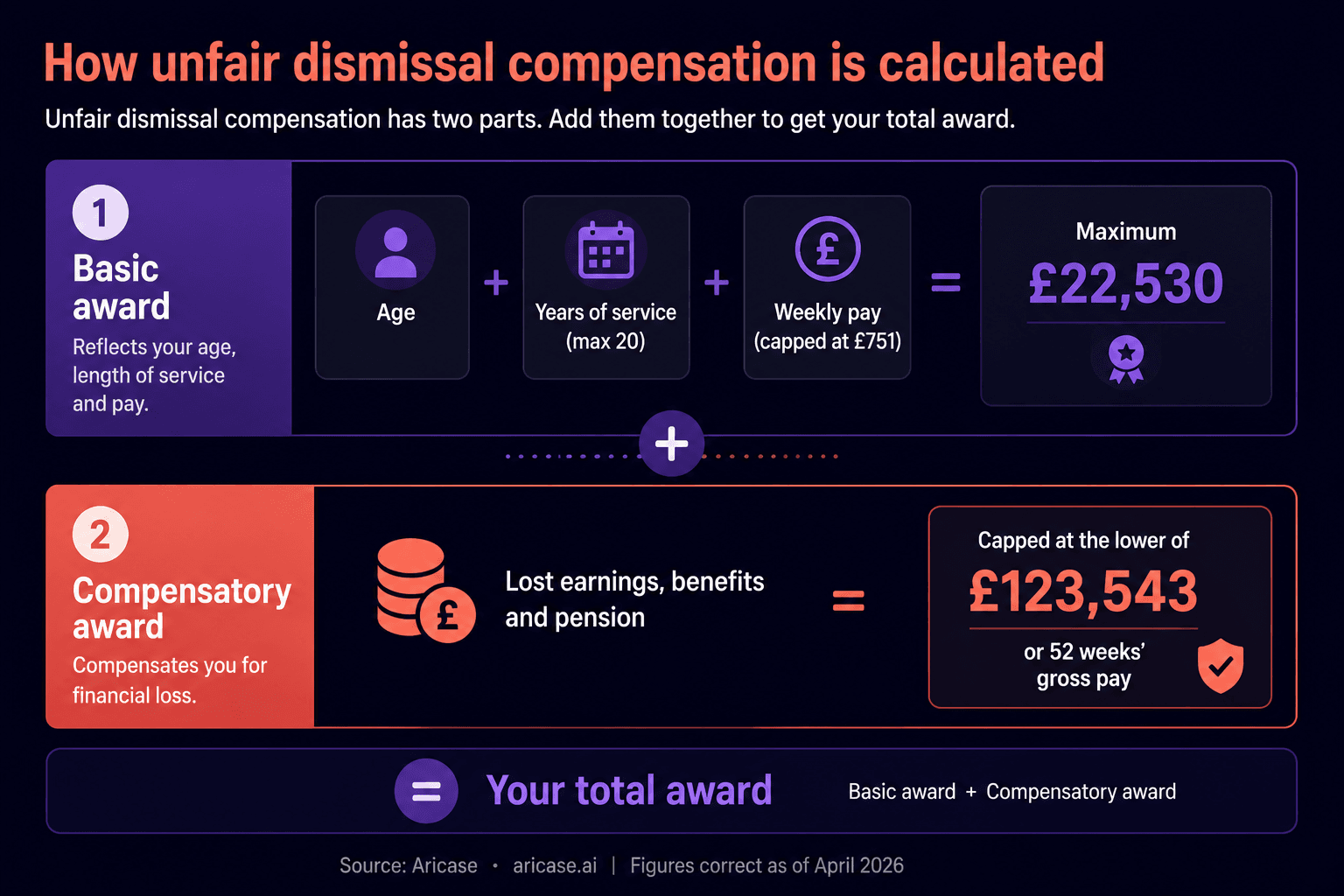
A successful unfair dismissal claim usually produces two separate sums.
The basic award is a fixed formula, calculated exactly like statutory redundancy pay: it depends on your age, your length of service (capped at 20 years) and your weekly pay (capped at a statutory figure updated each April). The redundancy pay guide walks through the formula with a worked example - the same arithmetic applies here.
The compensatory award covers your actual financial losses flowing from the dismissal: lost earnings from the dismissal date until you found (or should reasonably find) new work, lost benefits such as pension contributions and private health cover, loss of statutory rights, and reasonable job-search expenses.
The compensatory award is capped at the lower of a statutory limit or 52 weeks' gross pay. The statutory limit changes every April - check the current figure on GOV.UK before estimating. For most workers the 52-weeks-of-pay limb is the one that bites: if you earned £30,000, your compensatory award cannot exceed £30,000 however long you are out of work.
A worked example
Take someone aged 40, earning £28,000 a year (about £538 a week), dismissed after 6 years' service, who finds an equivalent job 5 months later.
- Basic award: 6 years at 1 week's pay per year = 6 weeks. Whether the full £538 or the statutory weekly cap is used depends on where the cap sits at the time - check GOV.UK.
- Compensatory award: roughly 5 months of net lost earnings plus lost pension contributions, less anything earned in the meantime.
For a quick, indicative ballpark of the total from your salary and length of service, try the employment claim value estimator - it gives a range, not a prediction.
When the tribunal asks you to set these figures out formally, you do it in a schedule of loss - the line-by-line document that totals your claim. The total is real money, but it is anchored to actual loss - not a windfall. Someone who walks into a new job the following week may have a strong claim on liability and still recover very little, because the law compensates loss rather than punishing the employer.
When compensation is uncapped
Two important categories have no cap on the compensatory element:
- Discrimination claims under the Equality Act 2010
- Whistleblowing (protected disclosure) dismissals and detriments
This is why the largest published awards are almost always discrimination or whistleblowing cases, typically involving long periods of lost career earnings.
Discrimination awards can also include injury to feelings - compensation for the hurt and distress caused, separate from financial loss. Tribunals value injury to feelings using the Vento bands, three brackets set out in Presidential Guidance and updated each year:
- Lower band - isolated or one-off acts
- Middle band - more serious cases that do not merit the top band
- Upper band - the most serious cases, such as a lengthy campaign of harassment
Aggravated damages and, rarely, damages for personal injury can be added in the most serious cases.
What can increase an award
The ACAS uplift. If your employer unreasonably failed to follow the ACAS Code of Practice on disciplinary and grievance procedures - for example, dismissing you with no hearing and no appeal - the tribunal can increase the award by up to 25%. The same mechanism works in reverse: if you unreasonably failed to follow the Code (for instance, by never raising a grievance), your award can be reduced by up to 25%.
Failure to provide written particulars. A tribunal can add 2 to 4 weeks' pay where the employer never provided a written statement of employment particulars.
Automatic unfair dismissal minimums. Some dismissals - for example, health and safety or whistleblowing dismissals - carry a higher minimum basic award.
What can reduce an award
Tribunals routinely reduce compensation, and these deductions are where many claimants are caught out:
- Failure to mitigate. You are expected to look for comparable work. A tribunal can cut the compensatory award if you made no reasonable effort to find a new job.
- Polkey reductions. If a fair procedure would probably have led to the same dismissal anyway, the award is reduced by that probability - sometimes to almost nothing.
- Contributory fault. If your own conduct contributed to the dismissal, both the basic and compensatory awards can be reduced, in serious cases by 100%.
- Payments already made. Any redundancy or ex-gratia payment from the employer is offset against the award.
Other common money claims
Not every claim follows the unfair dismissal structure:
- Unpaid wages and unlawful deductions - the award is simply the money owed. See the unpaid wages guide.
- Wrongful dismissal (notice pay) - damages equal to what you would have earned during your notice period.
- Redundancy pay - the statutory formula, as a fixed entitlement.
- Holiday pay - the accrued, untaken leave you were not paid for.
Tax on tribunal awards
Termination-related compensation - including the basic award and most of the compensatory award - is generally tax-free up to £30,000. Anything that replaces earnings, such as notice pay or an award of unpaid wages, is taxable as income in the normal way. For larger awards, tribunals "gross up" the sum above £30,000 so that you receive the intended amount after tax.
Keep the numbers realistic
Two reality checks are worth holding onto. First, median awards are modest - the tribunal statistics guide shows how far typical outcomes sit below the headline maximums. Second, most claims never reach a hearing: they settle through ACAS or a settlement agreement, usually at a discount to the full claim value in exchange for certainty and speed.
Understanding what a tribunal could realistically award is the foundation for every decision that follows - whether to claim, what to accept, and when to walk away. And none of it matters if you miss the 3-months-less-1-day deadline, so check your dates first - and when you are ready to file, the ET1 claim form guide walks through setting out your claim and the compensation you are seeking.
This article is legal information, not legal advice. Award limits and the Vento band figures change regularly - always check the current figures on GOV.UK and in the Presidential Guidance before relying on them.
Sources used in this guide
- Employment Rights Act 1996 - Sections 118 to 126 (remedies)
- GOV.UK: Employment tribunals - if you win your case
- Presidential Guidance: Vento bands (injury to feelings)
- ACAS: Code of Practice on disciplinary and grievance procedures
Links to legislation.gov.uk, gov.uk, acas.org.uk and bills.parliament.uk are official sources. Always check the current version on the source site before relying on a specific point.
Frequently asked questions
Is there a maximum amount an employment tribunal can award?
For ordinary unfair dismissal, yes. The compensatory award is capped at the lower of a statutory limit (updated each April - check GOV.UK for the current figure) or 52 weeks' gross pay. Discrimination and whistleblowing awards have no cap.
What are the Vento bands?
The Vento bands are the three brackets tribunals use to value injury to feelings in discrimination claims: a lower band for one-off or isolated acts, a middle band for more serious cases, and an upper band for the most serious, such as a sustained campaign of harassment. The figures are updated each year in Presidential Guidance.
Do I have to pay tax on tribunal compensation?
Termination-related compensation is generally tax-free up to £30,000. Awards that replace earnings, such as notice pay or an award for unpaid wages, are taxable as income. How an award is structured affects what you actually receive.
Can my compensation be reduced?
Yes. Tribunals can reduce awards for contributory fault, for failure to mitigate losses by looking for new work, or where a fair process would have led to the same dismissal anyway (a Polkey reduction). Unreasonable failure to follow the ACAS Code can cut an award by up to 25%.
How much do most people actually receive?
Median awards are much lower than the maximums. Most successful unfair dismissal claims resolve for amounts in the low tens of thousands of pounds or less, and many claims settle before a hearing for less than a tribunal might award. Published tribunal statistics give a realistic picture.
Want to know what your claim is actually worth?
Aricase helps you build your case and understand the realistic value of your claim - basic award, lost earnings and deductions - before you decide what to do next.
Start your 7-day free trialOr use the free Employment claim value estimator.
Related guides
 Claims11 min read
Unfair Dismissal in the UK: Do You Have a Claim?
Plain-English guide to UK unfair dismissal: what counts, who can claim, time limits, and what compensation looks like at an employment tribunal.
Read guide Documents8 min read
Schedule of Loss: How to Calculate What You're Claiming
How to prepare a schedule of loss for an employment tribunal: what it is, the heads of loss to include, a worked example, and the mistakes to avoid.
Read guide Claims7 min read
Employment Tribunal Success Rate: What the 2025/26 Data Shows
Latest MoJ and Acas figures on employment tribunal success rates, claim volumes, settlement rates and waiting times - and what they really mean for your claim.
Read guide Claims9 min read
How UK Statutory Redundancy Pay Is Calculated
How statutory redundancy pay works in the UK: who qualifies, the age-banded formula, the weekly-pay cap, tax, and what to do if the redundancy is unfair.
Read guide Negotiation7 min read
Settlement Agreements: Should You Accept, Negotiate or Reject?
How UK settlement agreements work, what to negotiate first, which elements are tax-free, red flags to watch for before signing, and when to reject the offer.
Read guide Deadlines9 min read
Employment Tribunal Time Limits: 3 Months Less 1 Day, Explained
How UK employment tribunal time limits work - the 3 months less 1 day rule, trigger dates by claim type, how ACAS pauses the clock, and late claims.
Read guide