Constructive Dismissal Resignation Letter: How to Write One (With a Template)
This guide covers England and Wales. It is general information, not legal advice, and is not a substitute for advice about your own situation. Laws and figures change - always check the current position on GOV.UK before relying on any detail here.
Head the letter with your details and the date
Full name, job title, a personal address or email, and the date. Address it to whoever your contract names for resignations, usually your line manager or HR. With your last day, the date fixes the effective date of termination.
State that you are resigning because of your employer's conduct
Put the reason first: 'I am resigning in response to [the employer]'s conduct, which I consider to be a fundamental breach of my contract. I consider that I have been constructively dismissed.'
Set out a short dated chronology of the breach
Three to six dated lines: what happened, when, and who did it. In a last straw case, list the main earlier incidents, then the final one, and say it was the last straw.
Refer to the grievance you raised and what happened to it
Give the date you raised it, the date of any outcome or appeal, and what the employer did or failed to do. If it was ignored, say so.
Say whether you are resigning with or without notice, and from what date
Either 'I am not giving notice and my last day of employment is today, [date]' or 'I am giving [one week's] notice and my last day will be [date]', with the under-protest wording if you are working notice.
Ask for written confirmation, final pay, accrued holiday and your P45
Ask the employer to confirm receipt in writing, pay your final salary and any accrued but untaken holiday, and send your P45. The reply usually confirms the termination date.
Keep the tone factual and keep a copy
Short sentences, dates, no adjectives, one page where possible. Send it by email for the timestamp, copy it to a personal address, and keep the sent record with your grievance and the employer's replies.
Most resignation letters are written to keep things civil: thanks, a vague reason, an offer to help with the handover. A constructive dismissal resignation letter has a different job. Under section 95(1)(c) of the Employment Rights Act 1996, you count as dismissed if you resign, with or without notice, because your employer's conduct entitled you to leave without notice. The letter is where you say so, and it is the founding document of the claim: tribunals put it next to the ET1 claim form and ask whether the two tell the same story. This guide covers what the letter has to say, what to leave out, and a template; the legal test itself is in the constructive dismissal guide.
What does a constructive dismissal resignation letter have to do?
Four things, each matching part of the test:
- Show you resigned in response to the employer's conduct, not for an unrelated reason such as a better offer.
- Identify the breach, or the series of events, that you say was a fundamental breach of contract (the contractual test from Western Excavating (ECC) Ltd v Sharp [1978]). In a last straw case, name the series and the final incident. Constructive dismissal examples covers what tends to count.
- Say you are treating the contract as ended by that conduct. "I consider that I have been constructively dismissed" removes any doubt.
- Date it, and state your last day. Together they fix the effective date of termination, from which the tribunal time limit runs.
What to include, step by step
1. Your details and the date
Full name, job title, a personal address or email, and the date, addressed to your line manager or HR.
2. The reason, stated first
"I am resigning in response to [the employer]'s conduct, which I consider to be a fundamental breach of my contract. I consider that I have been constructively dismissed."
3. A short dated chronology of the breach
Three to six dated lines: what happened, when, and who did it. "On 3 September 2026 my salary was reduced by £6,000 a year without my agreement" is the level of detail that helps. In a last straw case, list the main earlier incidents, then the final one.
4. The grievance you raised and what happened to it
The date you raised it, any outcome or appeal dates, and what the employer did or failed to do. If you did not raise one, leave the paragraph out.
5. With or without notice, and from what date
"I am not giving notice and my last day of employment is today, [date]", or "I am giving [one week's] notice and my last day will be [date]".
6. Written confirmation, final pay, holiday and P45
Ask for written confirmation of receipt, your final salary, accrued but untaken holiday and your P45; the reply tends to confirm the termination date.
7. A factual tone
Short sentences, dates, no adjectives, one page; plain facts age better than anger.
Should you resign with notice or without notice?
Section 95(1)(c) covers both; the letter differs by one paragraph.
Without notice. "I am treating my contract as ended by this conduct and I am therefore not giving notice. My last day of employment is today, [date]." This is the cleaner legal signal. The cost is that your pay stops that day; if the claim succeeds, you may also be able to claim the notice pay you gave up.
With notice. "I am giving [one week's / my contractual] notice, and my last day of employment will be [date]. I am working my notice under protest so that I continue to be paid; this does not mean I accept the conduct described above." Giving notice does not by itself defeat the claim and keeps pay flowing, but working on, especially without the under-protest wording, hands the employer an affirmation argument.
An employee's statutory minimum notice is one week after a month's service (section 86 of the Employment Rights Act 1996); your contract may require more (GOV.UK: handing in your notice). For notice pay, pay in lieu and garden leave, see notice periods in the UK.
What to leave out of the letter
Each of these turns up in real resignation letters, and each gets used against the writer.
- Thanks and "exciting new opportunity" language. A tribunal may find you resigned for the new challenge, not the breach, which breaks the causation element.
- Accepting or minimising the breach. "I understand these things happen" reads as evidence the conduct was not serious enough to end the contract.
- Insults or threats. They cost credibility and get quoted back in the employer's response.
- Demands framed as ultimatums. "Unless I receive £5,000 by Friday I will go to tribunal" turns the letter into a negotiating position, not a resignation in response to the breach.
- A "without prejudice" heading. That label protects genuine settlement discussions from being shown to the tribunal; a resignation letter is an open document you want the tribunal to read.
- Apologies. "I am sorry to be leaving like this" suggests regret about a choice, not a contract ended by the employer.
- Anything untrue or overstated. The letter will be disclosed and tested; one wrong date hands the employer a credibility point.
Do you have to raise a grievance first?
No. A grievance is not a legal precondition, but in practice it usually matters. Under section 207A of the Trade Union and Labour Relations (Consolidation) Act 1992, an unreasonable failure to follow the ACAS Code of Practice on Disciplinary and Grievance Procedures can reduce compensation by up to 25%, and resigning without ever raising the problem is the classic trigger. The grievance and the employer's reply, or silence, also become evidence that you did not accept the breach.
Two cautions: the grievance does not pause the tribunal clock, which runs from the date your employment ends, and the letter can refer to a grievance that has not finished. How to write a grievance letter covers the grievance itself.
When to send it
Carry on for weeks or months after the breach without objecting and a tribunal may find you affirmed the contract, losing the right to treat the breach as a dismissal. The constructive dismissal guide covers how long is too long; in short, the letter follows the breach, or the failed grievance, closely enough that nobody can say you lived with it.
Constructive dismissal resignation letter template
A starting point to adapt to your facts, not legal advice. Replace the square-bracket text and delete what does not apply.
[Your full name]
>
[Your address]
>
[Date]
>
Dear [Name],
>
Resignation: constructive dismissal
>
I am writing to resign from my position as [job title] with immediate effect.
>
I am resigning in response to [employer name]'s conduct, which I consider to be a fundamental breach of my contract. In particular: on [date], [what happened, for example my pay was cut without my agreement]. On [date], [what happened next]. On [date], [the final incident], which I regard as the last straw.
>
I raised a formal grievance about this conduct on [date]. [It has not been answered. / The outcome of [date] did not address the breach. / My appeal of [date] was rejected on [date].]
>
I therefore consider that I have been constructively dismissed. I am treating my contract as ended by [employer name]'s conduct and I am not giving notice. My last day of employment is today, [date].
>
Please confirm receipt in writing, pay my final salary to today's date and my accrued but untaken holiday, and send me my P45.
>
Yours sincerely,
>
[Your full name]
If you are resigning with notice, replace the "not giving notice" paragraph with:
I therefore consider that I have been constructively dismissed. I am giving [one week's / my contractual] notice, and my last day of employment will be [date]. I am working my notice under protest, only so that I continue to be paid; I do not accept the conduct described above.
How to send it and what to keep
Email is usually the right channel: it carries a timestamp and a delivery record. Some contracts require notice in writing to a named person or by post; if so, send it both ways and keep the proof of postage. Copy it to a personal email address, because access to your work account can end the same day. Keep the sent copy, every reply, the grievance and the employer's responses together as one set; in the claim they are read as a sequence. The employment tribunal evidence guide covers the rest.
What happens after you send it
The date your employment ends is the effective date of termination: the day the resignation takes effect if you gave no notice, or the last day of the notice period if you did. Three things run from it.
- The tribunal time limit. The time limit is 6 months less 1 day from the date employment ended where that was on or after 1 October 2026 (3 months less 1 day if it ended before then), and ACAS Early Conciliation has to start within it. The employment tribunal deadlines guide and the deadline calculator work the date out.
- ACAS Early Conciliation. You must notify ACAS before a tribunal will accept the claim. It is free, pauses the clock while it runs, and lasts up to about 12 weeks for cases notified to ACAS on or after 1 December 2025.
- The claim form. Constructive dismissal is a route into an unfair dismissal claim, so the ordinary qualifying rules apply: you generally need 2 years' continuous service (6 months where employment ends on or after 1 January 2027), unless the reason behind the breach is automatically unfair or discriminatory. The ET1 form guide covers the form.
Key takeaway
The letter has one purpose: to record, on the day, that you left because of what your employer did. Say it plainly, name the conduct with dates, refer to the grievance, state your last day, and keep a copy. The tribunal deadline then runs from the date your employment ends, and ACAS has to be notified within it.
This article is legal information, not legal advice. Whether a resignation amounts to constructive dismissal depends on the whole picture, not the letter alone. If you are unsure how this applies to you, you may want to consider speaking to an employment law specialist or ACAS first.
How Aricase can help with a constructive dismissal resignation letter
- Put the events behind your resignation in date order, in your own words, so the chronology in your letter matches your case file.
- Prepare a draft grievance letter from the facts in your case file if you have not raised one yet.
- Keep your grievance, the employer's replies and the resignation letter together as evidence.
- See the effective date of termination and your ACAS and tribunal dates worked out by code, not estimated.
- Whether, and when, to resign stays your decision.
Your case plan, 30 messages with Ari, your first document and one review by Ari of a draft you wrote are free.
Start your case freeSources used in this guide
- Employment Rights Act 1996 - Section 95(1)(c)
- Employment Rights Act 1996 - Section 86 (minimum notice)
- ACAS guidance on constructive dismissal
- GOV.UK: Handing in your notice
- Trade Union and Labour Relations (Consolidation) Act 1992 - Section 207A (ACAS Code adjustment)
- ACAS Code of Practice on Disciplinary and Grievance Procedures
Links to legislation.gov.uk, gov.uk, acas.org.uk and bills.parliament.uk are official sources. Always check the current version on the source site before relying on a specific point.
Frequently asked questions
Do I have to use the words 'constructive dismissal' in my resignation letter?
No set words are required. What matters is that the letter makes clear you are resigning because of your employer's conduct and identifies that conduct. Saying 'I consider that I have been constructively dismissed' removes any doubt about what the letter is, which is why the template includes it.
Can I resign with notice and still claim constructive dismissal?
Yes. Section 95(1)(c) of the Employment Rights Act 1996 covers resignation with or without notice, and giving notice does not by itself defeat the claim. It keeps your pay flowing through the notice period. The risk is that working on can give the employer an affirmation argument, which is why the with-notice wording says you are working your notice under protest and do not accept the conduct.
Do I need to raise a grievance before I resign?
It is not a legal precondition, but in practice it usually matters. An unreasonable failure to follow the ACAS Code of Practice can reduce compensation by up to 25%, and resigning without ever raising the problem is the usual trigger. The grievance does not pause the tribunal time limit, which runs from the date your employment ends.
What is the time limit once I have sent the letter?
The time limit is 6 months less 1 day from the date employment ended where that was on or after 1 October 2026 (3 months less 1 day if it ended before then), and ACAS Early Conciliation has to start within it. The date is the effective date of termination: the day the resignation takes effect if you gave no notice, or the last day of the notice period if you did.
I already resigned and my letter did not mention the breach. Is the claim lost?
Not automatically. The tribunal looks at the real reason you left, and the grievance, your written objections and what was said at the time are all evidence of it. A letter that gave a different reason, such as a new job, is harder to explain. A prompt follow-up letter setting out the real reason can help, though it carries less weight than the original would have.
Key terms
About to send the letter?
Build your case with Ari first: put the events in date order, keep the grievance and the replies together, and map your situation against the legal test before a decision that is hard to undo. Every case graded on six areas.
The six areas, graded automatically: the roadmap, the strength of each issue, the timeline, the overall assessment, evidence gaps and any drafts.
Start your case freeOr use the free Employment tribunal deadline calculator.
Related guides
 Claims11 min read
Constructive Dismissal: Can You Claim, and What Is the Time Limit?
Can you claim constructive dismissal? The legal test, resignation timing and the time limit: 6 months less 1 day if employment ended from 1 October 2026.
Read guide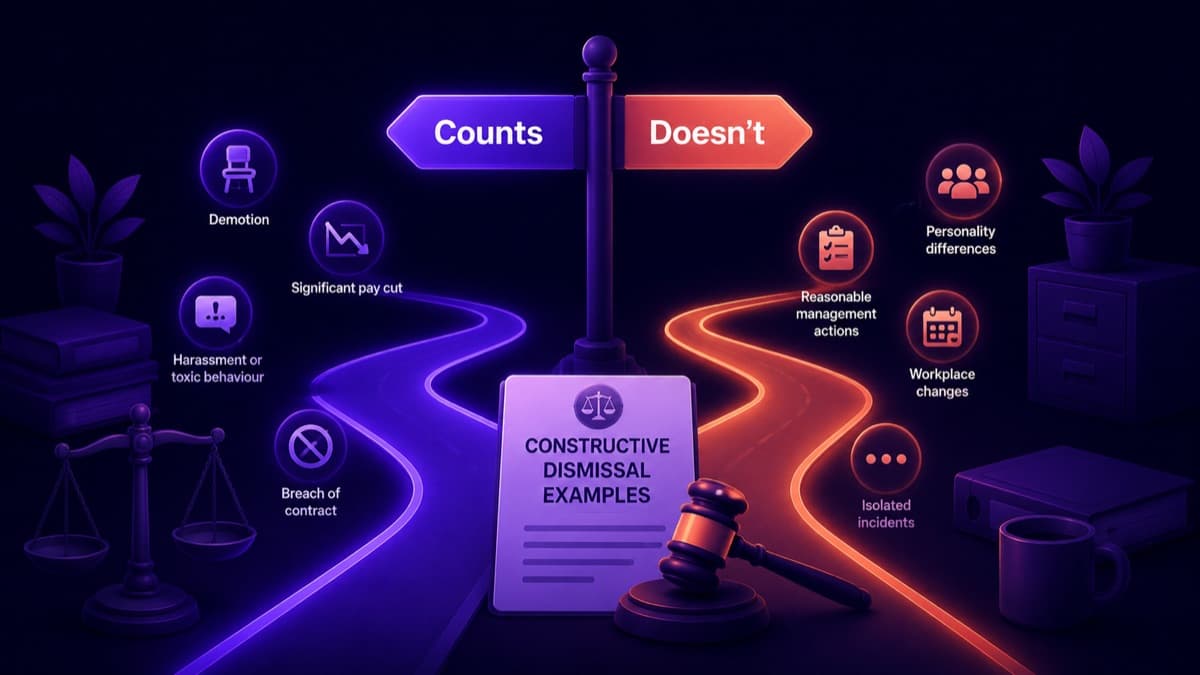 Claims9 min read
Constructive Dismissal Examples: What Does and Doesn't Count
Examples of constructive dismissal: pay cuts, demotion, bullying, ignored grievances - and why the same situation can go either way.
Read guide Documents9 min read
How to Write a Workplace Grievance Letter
A plain-English guide to writing a formal grievance letter in the UK: what to include, where to send it, and how it affects an employment tribunal claim.
Read guide Deadlines9 min read
Employment Tribunal Time Limits: 6 Months Less 1 Day, Explained
Employment tribunal time limits for unfair dismissal and discrimination: 6 months less 1 day for events from 1 October 2026, the ACAS pause, late claims.
Read guide Documents10 min read
How to Fill In Your ET1 Employment Tribunal Claim Form
How to fill in and file the ET1 employment tribunal claim form online: what each section asks, the claim narrative, the remedy and mistakes to avoid.
Read guide Rights8 min read
Notice Periods in the UK: Your Rights Explained
The notice UK employees are entitled to: statutory minimums under the Employment Rights Act 1996, notice pay, PILON, garden leave, and unpaid notice.
Read guide