What Happens at an Employment Tribunal Hearing
This guide covers England and Wales. It is general information, not legal advice, and is not a substitute for advice about your own situation. Laws and figures change - always check the current position on GOV.UK before relying on any detail here.
For a lot of people, the hearing is the part they have been quietly dreading since the day they decided to claim. The picture in your head is probably the worst-case one: a wood-panelled courtroom, a hostile barrister, a moment where you freeze and it all falls apart. The reality is usually calmer and more ordinary - often a meeting room or a video call, with a judge whose job is to follow a structured process, not to catch you out. Not knowing what to expect is its own kind of stress, so this guide walks through exactly what happens before, during, and after the day.
By the time you have a date for your employment tribunal hearing, the hard preparation is mostly behind you. Tribunal hearings are public, there are no fees, and many now take place by video rather than in a courtroom.
This piece is about the hearing. For the wider question of how to prepare and run a case on your own, the self-representation guide is the home for that, and we delegate the deeper preparation detail there.
What happens before the hearing?
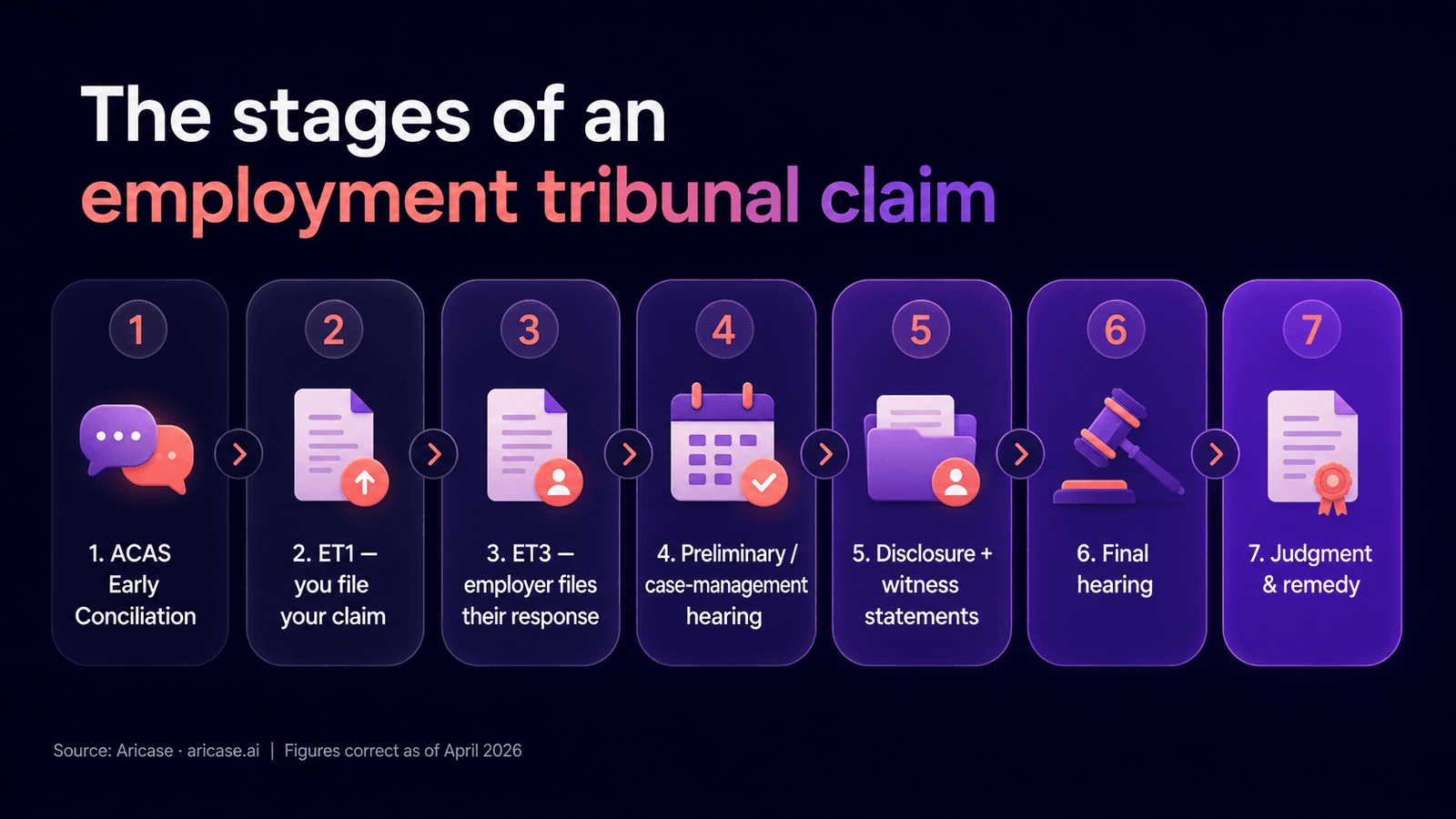
A final hearing is the end of a process, not the start. After your claim is accepted, the tribunal usually holds a preliminary stage and issues case-management orders - a timetable of what each side must do and by when. These orders are not optional. Missing them can lead to your claim being struck out, so the first rule is to diarise every date and meet it.
The orders typically cover three things:
- Disclosure. Each side must share the documents relevant to the issues, helpful or unhelpful. You cannot keep back a document just because it harms your case.
- The bundle. The parties agree a single, paginated set of all the documents the tribunal will use. The tribunal works only from this agreed bundle, so make sure your key documents are in it, with clear page numbers.
- Witness-statement exchange. Each witness writes a statement, and the two sides usually exchange them simultaneously on a set date so neither can tailor theirs to the other's.
Disclosure and bundle mechanics have their own detail - what to include, how to organise it, how tribunals weigh different kinds of evidence. That all lives in the employment tribunal evidence guide, which we delegate to here.
The week-before checklist
In the final week, work through a short list: confirm the date, time, and format; check the bundle and witness statements are final and identical to the other side's copies; line up any witnesses and make sure they can attend; re-read your own statement and the key documents; and request any reasonable adjustments you need (for a disability, language support, or anything that affects your ability to take part). Tribunals expect to accommodate these and it is better to ask early.
Who is in the room?
The make-up of the panel depends on your claim. An employment judge sits alone for most unfair dismissal and unpaid wages claims. For discrimination and whistleblowing claims, a panel of three normally sits: the judge plus two non-legal members who bring practical workplace experience, one often from an employer background and one from an employee or union background. They reach the decision together.
Also present will be a clerk (who handles the administration and logistics), the other side and their representative, any witnesses while they give evidence, and - because hearings are held in public - potentially members of the public or press. You do not need to worry about the public element; it is simply how open justice works.
In person or by video?
Many hearings now take place by video using the Cloud Video Platform (CVP), especially shorter and preliminary hearings, while longer contested final hearings are often in person. The tribunal tells you the format in advance.
If your hearing is by video, treat it with the same seriousness as an in-person one: a quiet room, a stable connection, your documents to hand, and the camera on throughout. If you have a strong reason to prefer one format, you can ask the tribunal to consider it.
How is the hearing day structured?
A final hearing follows a recognisable shape, though the judge controls the order and timing.
- Housekeeping and preliminary issues. The judge introduces everyone, confirms the issues to be decided, checks the bundle, and deals with any last-minute applications or points of procedure.
- Evidence. This is the heart of the hearing. Because written witness statements are usually taken as read - the panel reads them rather than having them read aloud - the live part is mostly cross-examination. Each witness confirms their statement is true, then is questioned.
- Cross-examination. The other side's representative asks your witnesses questions to test their evidence, and you do the same to theirs.
- Closing submissions. Each side sums up - drawing the evidence together and explaining why the facts and the law support their case. This can be spoken, written, or both.
What cross-examination is really like
For most people, cross-examination is the part they fear most. It is the other side's representative asking you questions designed to expose gaps or inconsistencies in your account, and it can feel adversarial. In practice it is more controlled than television makes it look. The judge supervises it and will stop questioning that is unfair, repetitive, or oppressive.
The approach that works is simple to state and harder to do under pressure: listen to the whole question, answer only what is asked, keep to the facts, point to the document if there is one, and do not argue or make speeches. If you genuinely do not know or cannot remember, say so - an honest "I don't recall" is far stronger than a guess that later unravels. When it is your turn to question their witnesses, ask the short, factual questions you prepared, each anchored to a page in the bundle.
How and when is the decision given?
Sometimes the tribunal gives its judgment orally at the end of the hearing, explaining the outcome and the main reasons, with fuller written reasons to follow. In more complex cases - many discrimination claims, for example - it reserves judgment, meaning it sends a written decision later, which can take several weeks.
If you win, the tribunal then turns to remedy - what you are owed. Sometimes remedy is dealt with at the same hearing; in other cases it is held over to a separate remedy hearing where compensation is argued and decided.
What happens after the hearing?
Two routes exist if the outcome did not go your way, and they are narrow.
- Reconsideration. You can ask the same tribunal to reconsider its judgment where it is in the interests of justice - for example, where something went procedurally wrong. The window is short, so act quickly.
- Appeal. You can appeal to the Employment Appeal Tribunal, but only on a point of law - not simply because you disagree with the findings of fact. The deadline is strict: generally 42 days from the date the written judgment or reasons were sent. See GOV.UK's appeal guidance for the current process before relying on any date.
Practical points for the day
A few small things make a real difference:
- What to wear: smart, plain, comfortable clothing - treat it like a formal interview. There is no need for anything elaborate.
- What to bring: your copy of the bundle and witness statements, a notebook and pen, water, and your timetable. For a video hearing, have all of this open and to hand.
- Breaks and pace: hearings run with breaks, and you can ask for a short pause if you need to compose yourself or check a document. The judge would rather you took a moment than struggled on.
- Adjustments: if you need them and have not arranged them, raise it at the start - it is never too late to ask.
Filing the claim correctly in the first place is its own task, covered in the ET1 form guide, which is the home for getting the claim form right.
Key takeaway
An employment tribunal hearing is more structured and less theatrical than people fear. The preparation - meeting the orders, agreeing the bundle, writing a clear statement, planning your cross-examination - is what wins or loses cases, and by the time you reach the hearing most of that work is done. On the day, your job is to give honest evidence, test theirs calmly, and explain plainly why the facts support your claim.
This article is legal information, not legal advice. Tribunal procedure can vary between cases and is subject to change. If you are unsure how any of this applies to your situation, you may want to consider speaking to an employment law specialist.
Sources used in this guide
- GOV.UK - Make a claim to an employment tribunal
- Employment Tribunal Rules of Procedure 2024
- ACAS - Going to an employment tribunal
- Courts and Tribunals Judiciary - Employment Tribunals
- GOV.UK - Appeal to the Employment Appeal Tribunal
Links to legislation.gov.uk, gov.uk, acas.org.uk and bills.parliament.uk are official sources. Always check the current version on the source site before relying on a specific point.
Frequently asked questions
What happens at an employment tribunal?
An employment tribunal hearing is a public hearing where a judge, sitting alone or with a panel of three, decides your claim. The day runs in a set order: housekeeping and preliminary issues, then evidence tested by cross-examination, then closing submissions from each side. Witness statements are usually taken as read rather than read aloud, and judgment is either given orally on the day or reserved in writing. There are no hearing fees, and many hearings now take place by video.
Are employment tribunal hearings public?
Yes. Employment tribunal hearings are held in public, and members of the public and press can attend. There are no fees to bring or attend a claim. Some hearings, or parts of them, can be held in private where there is a specific legal reason, but the default is an open, public hearing.
Will my employment tribunal hearing be in person or by video?
It can be either. Many hearings now take place by video using the Cloud Video Platform (CVP), particularly shorter and preliminary hearings, while longer or contested final hearings are often in person. The tribunal tells you the format in advance. If you have a strong reason to prefer one over the other, you can ask the tribunal to consider it.
Who decides my case at the hearing?
It depends on the type of claim. An employment judge usually sits alone for unfair dismissal and unpaid wages claims. For discrimination and whistleblowing claims, a panel of three normally sits - the judge plus two non-legal members who bring workplace experience. All of them weigh the evidence and reach the decision together.
What is cross-examination actually like?
Cross-examination is when the other side's representative asks you questions to test your evidence. It can feel adversarial, but the judge controls it and will stop unfair or repetitive questioning. The best approach is to listen carefully, answer only the question asked, keep to the facts, and say so honestly if you do not know or cannot remember something.
When will I get the tribunal's decision?
Sometimes the tribunal gives its judgment orally at the end of the hearing, with written reasons to follow. In more complex cases it reserves judgment and sends a written decision later, which can take some weeks. If you win, remedy (compensation) may be dealt with at the same hearing or at a separate remedy hearing.
Hearing date in the diary?
Ari helps you build your bundle, witness statement and cross-examination plan step by step - with a human quality check along the way.
Start your 7-day free trialOr explore our free employment law calculators.
Related guides
 Process11 min read
Going to Employment Tribunal Without a Solicitor
Yes - you can take your employer to tribunal without a solicitor. The stage-by-stage journey, the bundle and witness statement, the costs risk, and free help.
Read guide Process10 min read
Employment Tribunal Evidence: A Complete Guide
What counts as evidence at an employment tribunal, how to gather it, how a trial bundle works, and what to do if your employer withholds documents.
Read guide Documents10 min read
How to Fill In Your ET1 Employment Tribunal Claim Form
How to fill in the ET1 claim form, section by section: the respondent, the claim narrative, the remedy section, and the mistakes that sink cases.
Read guide Claims7 min read
Employment Tribunal Success Rate: What the 2025/26 Data Shows
Latest MoJ and Acas figures on employment tribunal success rates, claim volumes, settlement rates and waiting times - and what they really mean for your claim.
Read guide