Schedule of Loss: How to Calculate What You're Claiming
This guide covers England and Wales. It is general information, not legal advice, and is not a substitute for advice about your own situation. Laws and figures change - always check the current position on GOV.UK before relying on any detail here.
If your employment tribunal claim gets past the early stages, the tribunal will order you to produce a schedule of loss. It is one of the most important documents in your case, and one of the most misunderstood. It is not a description of what your employer did - that belongs in your witness statement. The schedule of loss is the arithmetic: a line-by-line statement of exactly what you are asking the tribunal to award, in pounds.
This guide explains what a schedule of loss is, when you have to produce one, the heads of loss that go into it, and how to lay it out - with a worked example. It does not re-explain how each individual figure is calculated; the employment tribunal compensation guide does that in detail, including the statutory caps and how awards can be increased or reduced. For a quick indicative ballpark of your total before you build the document, the employment claim value estimator gives a range from your salary and length of service. Here the focus is the document itself.
What is a schedule of loss?
A schedule of loss is a written breakdown of the compensation you are claiming, organised into separate "heads of loss" and added up to a total. It translates your claim from a story about unfair treatment into a number the tribunal can award.
It does two jobs. First, it tells the tribunal and the employer what is financially at stake, which is often what gets meaningful settlement talks started. Second, at the final hearing it frames the remedy stage - once a tribunal has decided you have won, it turns to your schedule to decide what to award.
A schedule of loss is not evidence in itself. The documents that prove the figures - payslips, pension statements, your record of applying for jobs - are your evidence. The schedule simply pulls those figures together into the claim total.
When you have to produce one
The tribunal orders a schedule of loss as part of its case management directions - the timetable of steps both sides must take before the final hearing. These directions are usually issued after the employer files its response, often at or following a preliminary hearing, and they set a deadline by which your schedule must be served on the employer and sent to the tribunal.
Treat it as a living document. Your losses change as time passes - if you stay out of work longer, your loss of earnings grows; if you find a new job, your future loss shrinks. You are normally expected to update the schedule as the hearing approaches so it reflects your position on the day, not the position months earlier.
The heads of loss
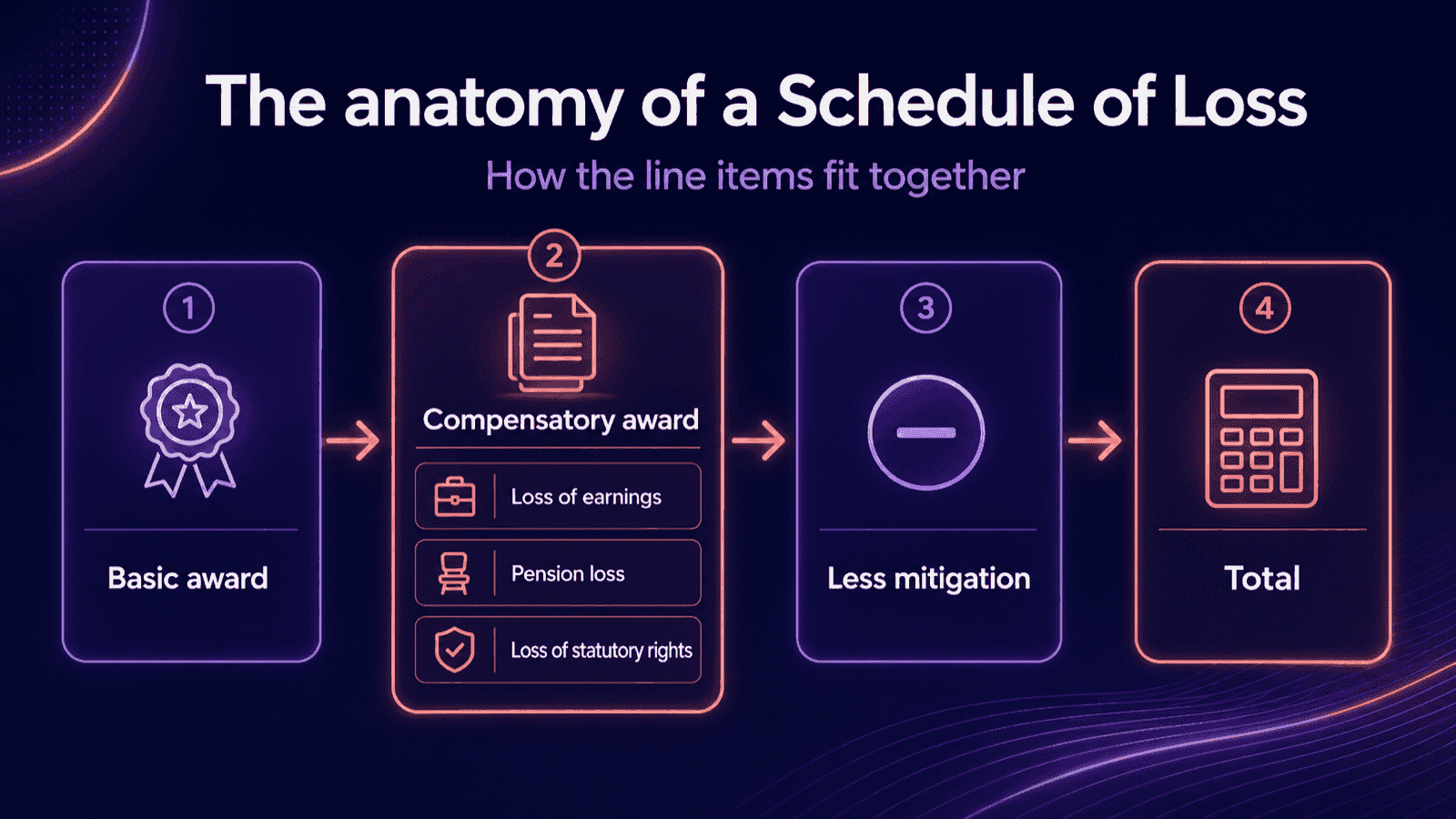
A schedule sets out each type of loss as its own line. Which heads apply depends on your claim - an unfair dismissal schedule looks different from a discrimination one. The common heads are:
- Basic award - a fixed formula based on age, length of service and weekly pay, calculated like statutory redundancy pay. The redundancy pay guide walks through the same arithmetic.
- Loss of earnings to date - net pay you have lost from the dismissal date up to the hearing, after deducting anything you have earned in the meantime.
- Future loss of earnings - continuing loss after the hearing if you have not yet returned to equivalent pay, projected for a reasonable period.
- Loss of pension - the value of employer pension contributions you have lost. This can be significant and is easy to overlook.
- Loss of statutory rights - a conventional small sum (commonly a few hundred pounds) to reflect having to build up unfair dismissal protection again in a new job.
- Injury to feelings - in discrimination claims only, an award for the distress caused, valued using the Vento bands set out in Presidential Guidance and updated each year.
- Interest - in discrimination claims, interest can be added to past losses and the injury to feelings award.
How each of these figures is actually worked out - and the statutory cap that limits the compensatory award in an ordinary unfair dismissal claim - is covered in the compensation guide. Do not reproduce that reasoning in the schedule; the schedule shows the numbers, not the workings.
Mitigation and the deductions to expect
A schedule of loss is only credible if it accounts for mitigation - your duty to look for comparable new work. Any pay from a new job, and certain benefits received, are deducted from your loss of earnings, and your schedule should show those deductions openly rather than leaving the employer to find them.
Other reductions a tribunal may apply - a Polkey reduction, a reduction for contributory fault, or an adjustment of up to 25% for an unreasonable failure to follow the ACAS Code - are explained in the compensation guide. You do not have to argue against yourself in your own schedule, but you can expect the employer's counter-schedule to raise them. Building your figure on honest, evidenced losses is what makes it hold up.
A worked example
Take someone earning £30,000 a year (about £2,000 net a month), dismissed after several years' service, who is out of work for four months and then starts a new job paying £24,000.
| Head of loss | Figure |
|---|---|
| Basic award (per the statutory formula) | £2,800 |
| Loss of earnings to date (4 months net) | £8,000 |
| Future loss (lower pay, projected 6 months) | £3,000 |
| Loss of pension | £1,400 |
| Loss of statutory rights | £500 |
| Subtotal | £15,700 |
| Less earnings already received since dismissal | (already netted above) |
| Total claimed | £15,700 |
The figures here are illustrative - yours come from your own payslips and pension statements, and the compensatory total may be limited by the statutory cap. The point the example shows is the structure: real money, anchored to actual loss, with mitigation built in rather than ignored. A claimant who walked straight into an equivalent job the following week might have a strong case on liability and still recover very little, because compensation reflects loss rather than punishing the employer.
Common mistakes to avoid
- Treating it as a wish list. Inflated figures collapse under the employer's counter-schedule and damage your credibility on everything else.
- Forgetting pension loss. It is one of the larger heads and one of the most commonly missed.
- Ignoring mitigation. Leaving out earnings since dismissal, or showing no evidence of job-hunting, invites a finding that you failed to mitigate.
- Letting it go stale. A schedule that still shows you as unemployed when you started work two months ago is quickly exposed.
- Confusing it with your statement. The schedule is numbers and headings, not narrative - keep the story for your witness statement.
Key takeaway
A schedule of loss is where your claim becomes a number, so it deserves the same care as the rest of your case. Build it from documents you can prove, show your mitigation openly, keep it updated, and keep the figure realistic. It will be used at the final hearing to decide what you are awarded, and long before that it often shapes whether the case settles. None of it matters, though, if you miss the 3-months-less-1-day deadline to bring the claim in the first place - so check your dates first, then build the schedule that puts a defensible figure in front of the tribunal.
This article is legal information, not legal advice. Award limits and the Vento band figures change regularly - always check the current figures on GOV.UK and in the Presidential Guidance before relying on them.
Sources used in this guide
- Employment Rights Act 1996 - Sections 118 to 126 (remedies)
- Employment Tribunals Rules of Procedure 2024 (case management)
- GOV.UK: Make a claim to an employment tribunal
- Presidential Guidance: Vento bands (injury to feelings)
Links to legislation.gov.uk, gov.uk, acas.org.uk and bills.parliament.uk are official sources. Always check the current version on the source site before relying on a specific point.
Frequently asked questions
What is a schedule of loss in an employment tribunal claim?
It is a document setting out, line by line, the compensation you are asking the tribunal to award. It breaks your claim into separate heads of loss - such as the basic award, lost earnings, pension loss and injury to feelings - and totals them, after deducting anything you have earned since. It is the financial summary of your claim, not your account of what happened.
When do I have to produce a schedule of loss?
The tribunal usually orders one as part of its case management directions, often at or shortly after a preliminary hearing, with a deadline before the final hearing. It is a living document - you are normally expected to update it as your losses change, for example if you find new work or remain unemployed for longer.
Do I need a solicitor to prepare a schedule of loss?
No. Many claimants prepare their own. The arithmetic follows set rules and the figures come from your payslips, pension statements and job-search records. The main risk of doing it alone is overstating losses or missing the deductions a tribunal will apply, which is why it helps to have the figures checked before you serve it.
What is the difference between a schedule of loss and a counter-schedule?
Your schedule of loss sets out what you say you are owed. The employer's counter-schedule is their response - it challenges your figures, applies deductions and states what they say the claim is really worth. Comparing the two is often where settlement discussions begin.
Will overstating my schedule of loss harm my claim?
It can. Tribunals expect a realistic, honest figure. An inflated schedule that ignores earnings since dismissal or claims unrealistic future loss can damage your credibility and is quickly exposed in the employer's counter-schedule. A modest, well-evidenced figure is far more persuasive.
Not sure what your claim is actually worth?
Aricase helps you build your schedule of loss - the basic award, lost earnings, pension loss and deductions - and have it checked, so the figure you put before the tribunal is realistic and defensible.
Start your 7-day free trialOr use the free Employment claim value estimator.
Related guides
 Claims9 min read
Employment Tribunal Compensation: How Awards Are Calculated
How employment tribunal compensation works in England and Wales: basic and compensatory awards, the statutory cap, Vento bands, uplifts, deductions and tax.
Read guide Process10 min read
Employment Tribunal Evidence: A Complete Guide
What counts as evidence at an employment tribunal, how to gather it, how a trial bundle works, and what to do if your employer withholds documents.
Read guide Process10 min read
What Happens at an Employment Tribunal Hearing
What happens at an employment tribunal hearing in England and Wales: the bundle, witness statements, cross-examination, who is in the room, and judgment.
Read guide Process6 min read
ACAS Early Conciliation: How It Works, Step by Step
What ACAS Early Conciliation is, why it is mandatory before an employment tribunal claim, and what to expect at each stage of the process.
Read guide Deadlines9 min read
Employment Tribunal Time Limits: 3 Months Less 1 Day, Explained
How UK employment tribunal time limits work - the 3 months less 1 day rule, trigger dates by claim type, how ACAS pauses the clock, and late claims.
Read guide