Employment Tribunal Time Limits Are Changing to 6 Months
This guide covers England and Wales. It is general information, not legal advice, and is not a substitute for advice about your own situation. Laws and figures change - always check the current position on GOV.UK before relying on any detail here.
The employment tribunal time limit is moving from 3 months less 1 day to 6 months. It is the most practically significant change in the Employment Rights Act 2025 for anyone considering a claim, because time limits end more claims than merits ever do.
It is also being reported almost universally as a single change arriving in October 2026. It is not. It is arriving in two halves, on two different legal tracks, and the half that is actually secured is not the half most coverage focuses on.
Law status - last updated 20 August 2026: The extension for breach of contract and wrongful dismissal claims in the tribunal is made law, in force 1 October 2026 (SI 2026/759). The extension for unfair dismissal, discrimination and unpaid wages is in section 152 of the Employment Rights Act 2025, which legislation.gov.uk marks prospective: "S. 152 not in force at Royal Assent". No commencement regulations had been made at the date of this review. Those claims stay at 3 months less 1 day.
What is already law
Two statutory instruments were made on 6 July 2026 and come into force on 1 October 2026. Neither depends on the Act being commenced, which is why they are secured while the headline reform is not.
SI 2026/759 amends article 7 of the Employment Tribunals Extension of Jurisdiction (England and Wales) Order 1994 - the instrument that lets the tribunal hear contract claims at all. The amendment is one line: in paragraphs (a) and (b), "for 'three' substitute 'six'". That covers breach of contract and wrongful dismissal claims in the employment tribunal.
SI 2026/758 extends the same three-to-six change to seven sets of regulations, including:
- Part-time Workers (Prevention of Less Favourable Treatment) Regulations 2000
- Fixed-term Employees (Prevention of Less Favourable Treatment) Regulations 2002
- Exclusivity Terms in Zero Hours Contracts (Redress) Regulations 2015 and the 2022 successor
- Employment Relations Act 1999 (Blacklists) Regulations 2010
- Information and Consultation of Employees Regulations 2004
What is not law yet
Everything else. Section 152 introduces Schedule 12, which would change the time limit in around 19 enactments from three months to six - including section 111 of the Employment Rights Act 1996 for unfair dismissal and section 123 of the Equality Act 2010 for discrimination.
Section 152 has not been commenced. Section 111 still reads "three months", with the Schedule 12 amendment listed as yet to be applied. October 2026 is the government's stated target for this half, not a date on which anything currently happens.
The two tracks side by side
| Claim type | Limit today | From 1 October 2026 | Status |
|---|---|---|---|
| Breach of contract, wrongful dismissal | 3 months less 1 day | 6 months | Made law (SI 2026/759) |
| Part-time, fixed-term, zero-hours exclusivity, blacklists | 3 months less 1 day | 6 months | Made law (SI 2026/758) |
| Unfair dismissal | 3 months less 1 day | 6 months intended | Not commenced |
| Discrimination | 3 months less 1 day | 6 months intended | Not commenced |
| Unlawful deduction from wages | 3 months less 1 day | 6 months intended | Not commenced |
| Statutory redundancy payment, equal pay | 6 months | 6 months | Already 6 months |
Why the split matters more than it sounds
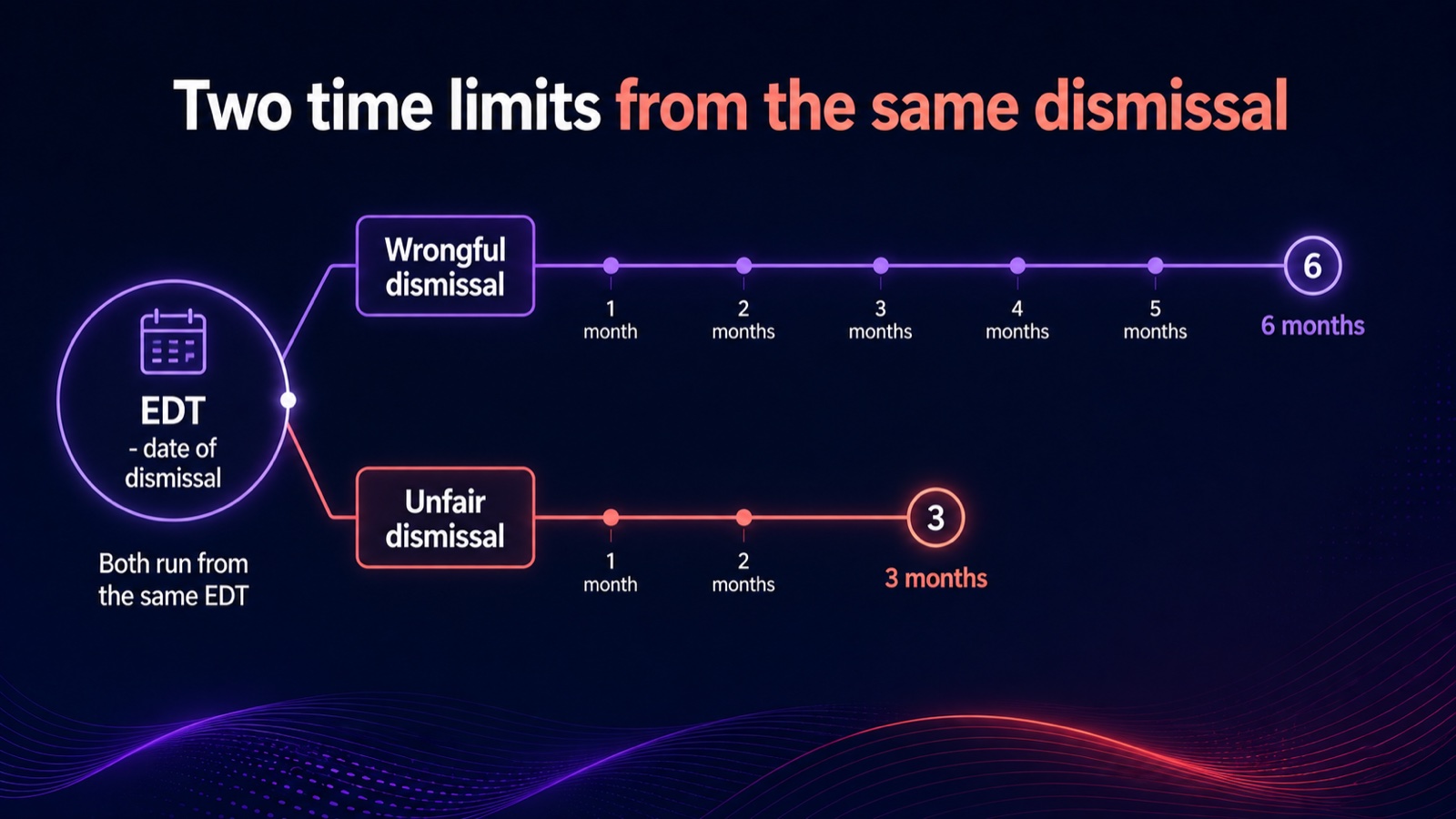
Take an ordinary dismissal without proper notice, with an effective date of termination of 1 November 2026. That single event usually generates two claims: unfair dismissal, and wrongful dismissal for the unpaid notice. See the wrongful dismissal guide for how the two differ.
On the law as it stands, those two claims would run to different deadlines from the same dismissal: six months for the wrongful dismissal claim, three months less one day for the unfair dismissal claim. The shorter one governs how fast you have to move, because ACAS has to be notified in time for both.
That is the exact opposite of what most current commentary implies, which is that contract claims are the ones left behind at three months. The practical rule is unchanged and simple: work to the shortest limit that applies to any claim you might bring.
Which rule applies to your claim today?
The rule in force on your trigger date is the rule that governs your claim. For unfair dismissal and discrimination, today, that is 3 months less 1 day in every case.
This is the part that matters more than anything else on this page. The failure mode is specific and severe: someone reads that the limit is now six months, waits, and finds at four months that their claim type was never commenced. There is no partial credit for that. As the missed deadline guide explains, tribunals can extend time only where it was not reasonably practicable to claim in time for unfair dismissal, or where it is just and equitable for discrimination, and a mistaken belief about the state of the law rarely satisfies either test.
So, until commencement is confirmed:
- Calculate from the 3-month rule. Your trigger date, plus 3 months, less 1 day.
- Notify ACAS well inside it. Notification is free, confidential, and pauses the clock.
- Do not wait for a grievance or internal appeal to finish. Internal processes have never stopped the tribunal clock, and none of this changes that.
- Check your dates rather than estimating them. The tribunal deadline calculator applies the counting rules, including the ACAS pause.
Will the change revive a claim that is already out of time?
No. Both instruments are expressly forward-looking.
SI 2026/759 applies only where "the effective date of termination of the contract giving rise to the claim occurs on or after 1st October 2026", or where there is no effective date of termination, the last day worked falls on or after that date. SI 2026/758 does not apply "where the relevant date occurs before 1st October 2026".
For the uncommenced half, the transitional provisions do not exist yet - they will sit in the commencement regulations when those are made. Anyone with a deadline running now is therefore in exactly the position they were in before the Act, and a near deadline is not a reason to slow down.
What is not changing
- ACAS Early Conciliation remains compulsory. You still cannot lodge an ET1 without a certificate.
- The stop-the-clock rule survives. Section 207B still pauses the deadline between notifying ACAS and the certificate date, and you still get at least one month from the certificate to file.
- Trigger dates are untouched. The effective date of termination for dismissal, the act complained of for discrimination, the last deduction in a series for wages.
- The extension discretions are unchanged. "Not reasonably practicable" and "just and equitable" remain the only routes to a late claim.
The full mechanics of how the clock runs, with a worked ACAS example, are in the employment tribunal deadlines guide. For the wider reform package, see the Employment Rights Act 2025 guide.
Key takeaway
A longer time limit is a real improvement, and it removes a trap that has ended a great many arguable claims on the calendar rather than the facts. But "the tribunal time limit is now six months" is not yet a true statement about unfair dismissal or discrimination, and treating it as one is how a good claim gets lost. Until GOV.UK and the commencement regulations confirm otherwise, the safe assumption for those claims is the current one: 3 months less 1 day, with ACAS notified as early as you can manage.
_This article is legal information, not legal advice. It describes law that is partly not yet in force; check legislation.gov.uk and the commencement regulations for the current position before relying on a longer time limit._
Sources used in this guide
- Employment Rights Act 2025 - Section 152 (increase in time limits)
- Employment Rights Act 2025 - Schedule 12 (increase in time limits for making claims)
- SI 2026/759 - Employment Tribunals Extension of Jurisdiction (England and Wales) (Amendment) Order 2026
- SI 2026/758 - Employment Tribunal (Extension of Time Limits) (Miscellaneous Amendments and Transitional Provisions) Regulations 2026
- ACAS: Employment Rights Act 2025
- Employment Rights Act 1996 - Section 111 (unfair dismissal time limit)
- Employment Rights Act 1996 - Section 207B (ACAS extension of time)
- Equality Act 2010 - Section 123 (discrimination time limit)
Links to legislation.gov.uk, gov.uk, acas.org.uk and bills.parliament.uk are official sources. Always check the current version on the source site before relying on a specific point.
Frequently asked questions
Has the employment tribunal time limit changed to 6 months?
Only for some claims. The extension for breach of contract and wrongful dismissal claims in the tribunal is already made law and takes effect on 1 October 2026. The much wider extension covering unfair dismissal, discrimination and unpaid wages sits in section 152 of the Employment Rights Act 2025, which legislation.gov.uk still marks as prospective with no commencement regulations made. Those claims remain at 3 months less 1 day.
Which claims get 6 months from 1 October 2026?
Breach of contract and wrongful dismissal claims brought in the employment tribunal, under the amendment made by SI 2026/759, where the effective date of termination falls on or after 1 October 2026. A further set of claims also moves to 6 months under SI 2026/758, including part-time and fixed-term worker less-favourable-treatment claims and zero-hours exclusivity claims. Statutory redundancy pay and equal pay claims already had a 6-month limit.
So is unfair dismissal still 3 months?
Yes, at the last review of this page. Schedule 12 of the Employment Rights Act 2025 would change section 111 of the Employment Rights Act 1996 from three months to six, but that amendment is listed as yet to be applied because section 152 has not been commenced. Until commencement regulations are made, tribunals apply the existing 3 months less 1 day limit to unfair dismissal claims.
If my deadline expires before the change, does the extension rescue my claim?
No. Both instruments are expressly forward-looking. SI 2026/759 applies only where the effective date of termination falls on or after 1 October 2026, and SI 2026/758 does not apply where the relevant date falls before that date. A limitation period that has already run is not revived.
Does ACAS Early Conciliation still pause the clock?
Yes. The stop-the-clock mechanism in section 207B of the Employment Rights Act 1996 is untouched by the Employment Rights Act 2025. You still have to notify ACAS before you can lodge a claim, the conciliation period still does not count towards your deadline, and you still get at least one month from the certificate date to file.
Not sure which deadline applies to you?
Ari works from your actual dates - dismissal, resignation, ACAS notification - and keeps the deadline in view while you build the case.
Build your case with AriOr use the free Employment tribunal deadline calculator.
Related guides
 Deadlines9 min read
Employment Tribunal Time Limits: 3 Months Less 1 Day, Explained
How UK employment tribunal time limits work - the 3 months less 1 day rule, trigger dates by claim type, how ACAS pauses the clock, and late claims.
Read guide Rights10 min read
Employment Rights Act 2025: What Has Changed and When
Plain-English summary of the Employment Rights Act 2025: what it introduces, when changes come into force, and what it means for an employment dispute now.
Read guide Process6 min read
ACAS Early Conciliation: How It Works, Step by Step
What ACAS Early Conciliation is, why it is mandatory before an employment tribunal claim, and what to expect at each stage of the process.
Read guide Deadlines8 min read
Missed the Employment Tribunal Deadline? You May Not Be as Late as You Think
Missed an employment tribunal deadline? When time can be extended, the 'not reasonably practicable' and 'just and equitable' tests, and what to do next.
Read guide Claims8 min read
Wrongful Dismissal: What It Is and How It Differs from Unfair Dismissal
Wrongful dismissal is a contract claim, not a statutory one: how it differs from unfair dismissal, what you can recover, and where to bring your claim.
Read guide Law Change8 min read
Will Unfair Dismissal Become a Day-One Right in the UK?
What the Employment Rights Act 2025 says about unfair dismissal, why unconditional day-one rights were dropped, and when the six-month period starts.
Read guide