How to Appeal Against a Dismissal: Grounds, Letter and Time Limits
This guide covers England and Wales. It is general information, not legal advice, and is not a substitute for advice about your own situation. Laws and figures change - always check the current position on GOV.UK before relying on any detail here.
Check the deadline and who hears the appeal
Read the dismissal letter and the disciplinary procedure for the appeal deadline, the person to send it to and the format. If the deadline is too short, ask in writing for more time before it passes.
Ask for the documents
Request the investigation report, witness statements, hearing notes and anything else the decision relied on, if you do not already have them. A subject access request can reach material the employer does not offer.
Write down your grounds
Number each ground and keep to facts: what was wrong with the process, which findings the evidence does not support, why the sanction was too harsh, and any new evidence.
Say what outcome you want
State the outcome you are asking for, such as reinstatement with back pay, or a lesser sanction in place of dismissal.
Send it and keep proof
Send the appeal by email or another route that gives a delivery record, before the deadline, and keep a copy.
Prepare for the appeal hearing
Ask to be accompanied by a colleague or trade union representative, prepare short notes on each ground, and take your own notes of what is said.
Keep the tribunal time limit in view
The appeal does not pause the time limit for a claim. If the appeal is still running as the limit approaches, ACAS Early Conciliation can be started at the same time.
Being dismissed often feels final. In most workplaces it is not quite: there is one more step, the appeal, and it matters in two ways. It is a genuine chance to have the decision reversed by someone who was not involved. And if the dismissal later reaches an employment tribunal, how you and your employer handled the appeal is part of the evidence. The ACAS Code of Practice on disciplinary and grievance procedures expects every dismissal letter to carry a right of appeal (paragraph 22) and expects an employee who thinks the decision is wrong to use it (paragraph 26).
The common belief is that an appeal is a formality the employer always rejects. Many are rejected. But a well-grounded appeal sometimes succeeds, and even when it fails it creates a written record of what was wrong while the facts are fresh. One trap catches many people: the appeal does not pause the tribunal clock.
This guide is about appealing within your employer's procedure. Appealing an employment tribunal judgment to the Employment Appeal Tribunal is a different process, on points of law only.
Do you have the right to appeal against a dismissal?
There is no free-standing statutory right to an internal appeal, but in practice it is close to one:
- The ACAS Code says employers allow an employee to appeal against any formal decision made, and that the dismissal letter states the right of appeal.
- Tribunals take the Code into account, and an employer's unreasonable failure to offer an appeal can increase compensation by up to 25% under section 207A of the Trade Union and Labour Relations (Consolidation) Act 1992.
- Fairness is judged on the whole process. A dismissal with no appeal at all, or an appeal heard by the manager who dismissed, is harder for an employer to defend as fair.
The Code applies to dismissals for misconduct and poor performance. It does not apply to redundancy dismissals or to the non-renewal of fixed-term contracts on expiry, though many employers offer an appeal in those cases too.
The 2015 Code is the version in force. ACAS consulted on a draft updated Code from 30 July to 23 September 2026 and is reviewing the responses; any new Code applies only once it is approved and brought into effect.
What does the ACAS Code say about appeals?
Paragraphs 26 to 29 of the Code set out four things:
- Grounds in writing. The employee lets the employer know the grounds for the appeal in writing.
- No unreasonable delay. The appeal is heard without unreasonable delay, ideally at an agreed time and place.
- Impartiality. The appeal is dealt with impartially and, wherever possible, by a manager who has not previously been involved in the case.
- A written outcome. The employee is told the result in writing as soon as possible.
You also have a statutory right to be accompanied at the appeal hearing by a fellow worker or a trade union representative or official (Employment Relations Act 1999, section 10; appeals fall within the definition in section 13). If your companion cannot make the proposed time, the employer must postpone to a reasonable time you propose within five working days.
What are good grounds for appealing a dismissal?
Grounds of appeal fall into four groups. Most strong appeals use more than one.
- The process was unfair. You were not told the allegations in enough detail, did not see the evidence before the hearing, were refused a companion, or the same person investigated and decided; the outcome looked decided in advance.
- The finding is not supported by the evidence. The investigation missed witnesses or documents you pointed to, relied on an account you never had a chance to answer, or reached a conclusion the evidence does not bear.
- The sanction was too harsh. Dismissal was outside the range of reasonable responses given your length of service, clean record, the circumstances or the way colleagues were treated for similar conduct. Inconsistency is a common and effective ground.
- New evidence. Something has come to light since the hearing: a witness, a document, a medical explanation.
If you believe the real reason for the dismissal was something else, such as discrimination, pregnancy, a health and safety complaint or a whistleblowing disclosure, the appeal letter is the place to say so in writing. The fair reasons for dismissal guide covers what the employer has to show, and gross misconduct explained covers the usual allegations.
How to appeal against dismissal, step by step
1. Check the deadline and who hears the appeal
The dismissal letter and the disciplinary procedure usually state the deadline, often around five working days, and who to write to. The deadline comes from your employer's procedure, not from statute. If it is too short to prepare properly, ask in writing for more time before it passes; a late appeal is still better than none.
2. Ask for the documents
You can ask for the investigation report, witness statements, the hearing notes and anything else the decision relied on. A subject access request can reach personal data the employer does not volunteer, but it can take a month or more, so the appeal does not wait for it.
3. Write down your grounds
Number each ground, keep to facts and dates, and say which part of the decision each ground attacks. Two pages is usually enough.
4. Say what outcome you want
Usually reinstatement with back pay, or a lesser sanction in place of dismissal. Stating it removes any doubt about what you are asking for.
5. Send it and keep proof
Email gives a timestamp and a delivery record. Copy it to a personal address, because access to work systems often ends on dismissal.
6. Prepare for the appeal hearing
Request a companion, prepare short notes on each ground and the documents that support them, and take your own notes. If no minutes arrive afterwards, send your own summary by email within a day or two.
7. Keep the tribunal time limit in view
The appeal and the time limit run in parallel. See the time-limit section below.
Appeal letter template
A starting point to adapt to your facts, not legal advice. Replace the square-bracket text and delete what does not apply.
[Your full name]
>
[Date]
>
Dear [Name of the person hearing appeals],
>
Appeal against dismissal
>
I am writing to appeal against the decision to dismiss me, set out in [name]'s letter of [date]. My employment ended on [date].
>
My grounds of appeal are:
>
1. [Process: for example, I was not given the witness statements before the hearing on [date], so I could not answer them.]
2. [Evidence: for example, the finding that I [allegation] does not take account of [document or witness], which shows [fact].]
3. [Sanction: for example, dismissal was too severe given my [number] years' service and clean disciplinary record, and [colleague's role] received a written warning for similar conduct in [month and year].]
4. [New evidence: for example, I attach [document], which was not available at the hearing.]
>
I ask that the decision be overturned and that I be reinstated with back pay. [Or: In the alternative, I ask that dismissal be replaced with a lesser sanction.]
>
Please send me, before the appeal hearing, copies of [the investigation report / witness statements / the notes of the disciplinary hearing]. I intend to be accompanied at the hearing by [name and role].
>
Please confirm receipt of this appeal.
>
Yours sincerely,
>
[Your full name]
What happens at the appeal hearing?
Employers run appeals in one of two ways:
- A review. The appeal manager looks at whether the original decision was reasonable on the evidence, focusing on the grounds you raised.
- A rehearing. The case is heard again in full, sometimes with witnesses.
Either way, the appeal can matter for fairness. Tribunals look at the process as a whole, so a thorough and impartial rehearing can correct defects at the first hearing (Taylor v OCS Group, 2006), while a superficial appeal can compound them.
The outcome is usually one of three: the dismissal is overturned, upheld, or replaced with a lesser sanction such as a final written warning, where the procedure allows it. If it is overturned, the dismissal is normally treated as never having happened: the contract continues and pay for the gap is due (Folkestone Nursing Home v Patel, 2018).
Does appealing a dismissal affect a tribunal claim?
Yes, in three ways.
It does not stop the clock. The time limit runs from the effective date of termination under section 97 of the Employment Rights Act 1996, normally the date the dismissal took effect, and an unsuccessful appeal does not move it (J Sainsbury v Savage, 1981). For most claims ACAS must be notified within 6 months less 1 day of that date where it was on or after 1 October 2026 (3 months less 1 day if it was before 1 October 2026). ACAS Early Conciliation can be started while the appeal is still running, and it pauses the clock while it lasts. The employment tribunal deadlines guide and the deadline calculator cover the dates.
Skipping it can cost you. If a tribunal finds you unreasonably failed to appeal, it can reduce compensation by up to 25%. The adjustment applies to the claims listed in Schedule A2, which include unfair dismissal, discrimination and unlawful deductions.
What is said becomes evidence. The appeal letter, the notes and the outcome go into the tribunal bundle. A clear, factual appeal written at the time often carries more weight than a later account.
A worked example of the 25% adjustment
Figures are illustrative, not a forecast. Suppose a tribunal finds a dismissal unfair and assesses compensation at £12,000.
- The employer refused any appeal. If the tribunal finds that unreasonable, it can increase the award by up to 25%, to as much as £15,000.
- The employer offered an appeal and the employee ignored it without good reason. The tribunal can reduce the award by up to 25%, to as little as £9,000.
The percentage is discretionary, anywhere from 0 to 25%, and depends on how serious and how deliberate the failure was. The employment tribunal compensation guide explains how the award itself is built.
Can you appeal if you have short service?
Yes. The appeal is part of your employer's procedure, so your length of service makes no difference to whether you can use it. It affects which claims follow. Ordinary unfair dismissal needs 2 years' continuous service where employment ends before 1 January 2027, and 6 months where it ends on or after that date, but discrimination claims and automatically unfair reasons need none. In those claims the ACAS Code adjustment can still apply.
Key takeaway
An appeal against dismissal costs nothing, sometimes reverses the decision, and protects your position if it does not. Use the deadline in your employer's procedure, put numbered grounds in writing, say what outcome you want, and take a companion. Keep the tribunal time limit in view throughout, because the appeal does not pause it.
This article is legal information, not legal advice. Disciplinary procedures differ between employers, and whether a dismissal was fair depends on the full facts. If you are unsure how this applies to you, you may want to consider speaking to an employment law specialist or ACAS.
How Aricase can help with an appeal against dismissal
- Set out what happened in date order, with the investigation, the hearing and the decision, so the grounds of appeal match the record.
- Prepare a draft appeal letter from the facts in your case file, in your own words.
- Keep the dismissal letter, the hearing notes and the appeal outcome together as evidence.
- See your ACAS and tribunal dates worked out by code, because the appeal does not stop the clock.
- Whether to appeal, and what to ask for, stays your decision.
Your case plan, 30 messages with Ari, your first document and one review by Ari of a draft you wrote are free.
Start your case freeSources used in this guide
- ACAS Code of Practice on disciplinary and grievance procedures (2015)
- ACAS: draft updated Code of Practice on disciplinary and grievance procedures (consultation closed 23 September 2026)
- ACAS: Disciplinary procedure step by step
- Trade Union and Labour Relations (Consolidation) Act 1992 - section 207A (ACAS Code adjustment)
- Trade Union and Labour Relations (Consolidation) Act 1992 - Schedule A2 (claims the adjustment applies to)
- Employment Relations Act 1999 - section 10 (right to be accompanied)
- Employment Relations Act 1999 - section 13 (meaning of disciplinary hearing)
- Employment Rights Act 1996 - section 97 (effective date of termination)
- GOV.UK: Dismissal - your rights
Links to legislation.gov.uk, gov.uk, acas.org.uk and bills.parliament.uk are official sources. Always check the current version on the source site before relying on a specific point.
Frequently asked questions
How long do I have to appeal against a dismissal?
There is no time limit in law for an internal appeal; the deadline is the one in your employer's procedure, usually stated in the dismissal letter and often around five working days. The ACAS Code says appeals are heard without unreasonable delay. If you need longer, ask in writing before the deadline passes, and appeal late rather than not at all.
Does appealing stop the tribunal time limit?
No. The time limit runs from the effective date of termination, normally the date the dismissal took effect, and an unsuccessful appeal does not move that date. For dismissals on or after 1 October 2026 ACAS must be notified within 6 months less 1 day (3 months less 1 day if the dismissal was before 1 October 2026). Early Conciliation can be started while the appeal is still running.
What happens if I do not appeal?
You do not lose the right to bring a claim. But under section 207A of the Trade Union and Labour Relations (Consolidation) Act 1992 a tribunal can reduce compensation by up to 25% if it finds you unreasonably failed to follow the ACAS Code, and the Code says an employee who feels a disciplinary decision is wrong or unjust appeals against it. The reduction is discretionary and depends on whether skipping the appeal was unreasonable in the circumstances.
What happens if my appeal succeeds?
Usually the dismissal is set aside and you return to work as if it had not happened, with pay for the time in between. In Folkestone Nursing Home v Patel (2018) the Court of Appeal held that a successful appeal revives the contract, so there is no dismissal left to claim for. The appeal manager may instead substitute a lesser sanction, such as a final written warning, if the procedure allows it.
Can I appeal a dismissal for redundancy?
Yes, if your employer offers an appeal, and most do. The ACAS Code does not apply to redundancy dismissals, so the 25% adjustment is not in play, but tribunals do look at whether an appeal was offered and how it was handled when deciding whether a redundancy dismissal was fair.
Key terms
Writing your appeal?
Build your case with Ari: put the dismissal in date order, draft the appeal from your case file in your own words, and keep the tribunal dates in view while the appeal runs. Every case graded on six areas.
The six areas, graded automatically: the roadmap, the strength of each issue, the timeline, the overall assessment, evidence gaps and any drafts.
Start your case freeOr use the free Employment tribunal deadline calculator.
Related guides
 Rights8 min read
Your Rights at a Disciplinary Hearing
Your disciplinary hearing rights in the UK - the ACAS Code, seeing the evidence in advance, the right to be accompanied, suspension and appeals.
Read guide Rights10 min read
Gross Misconduct: What Counts, Your Rights, and What You Are Owed
What counts as gross misconduct, common examples, first-offence dismissals, pay still owed, and when a gross misconduct dismissal may be unfair.
Read guide Claims11 min read
Unfair Dismissal: Can You Claim, and What Is the Time Limit?
Can you claim unfair dismissal? Who qualifies, what makes a dismissal unfair and the time limit: 6 months less 1 day if it took effect from 1 October 2026.
Read guide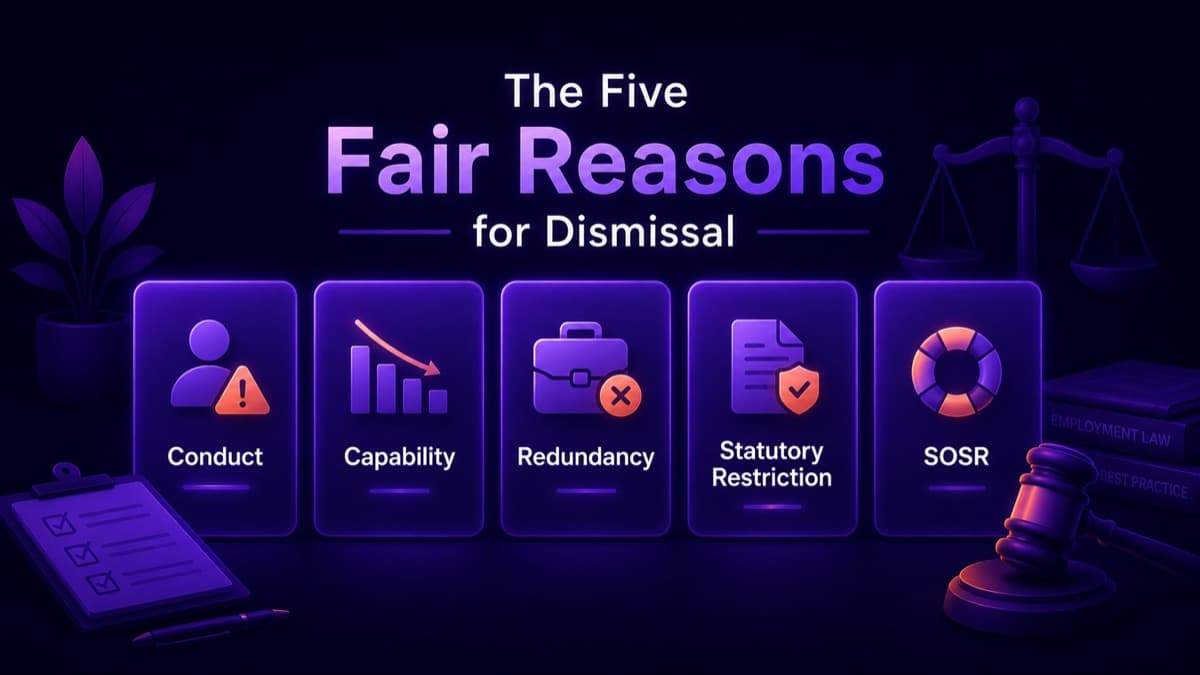 Rights9 min read
The 5 Fair Reasons for Dismissal Under UK Law
UK law allows only five potentially fair dismissal reasons: conduct, capability, redundancy, illegality, and SOSR. A fair reason is only half the test.
Read guide Documents9 min read
How to Write a Workplace Grievance Letter
A plain-English guide to writing a formal grievance letter in the UK: what to include, where to send it, and how it affects an employment tribunal claim.
Read guide Deadlines9 min read
Employment Tribunal Time Limits: 6 Months Less 1 Day, Explained
Employment tribunal time limits for unfair dismissal and discrimination: 6 months less 1 day for events from 1 October 2026, the ACAS pause, late claims.
Read guide Process6 min read
ACAS Early Conciliation: How It Works, Step by Step
What ACAS Early Conciliation is, why it is mandatory before an employment tribunal claim, and what to expect at each stage of the process.
Read guide