Is It Worth Going to an Employment Tribunal?
This guide covers England and Wales. It is general information, not legal advice, and is not a substitute for advice about your own situation. Laws and figures change - always check the current position on GOV.UK before relying on any detail here.
This guide explains the law and the options - it is not a recommendation about what to do. Whether to resign, accept, negotiate or reject is a decision only you can make, ideally with advice on your own circumstances.
Most people asking whether a tribunal claim is worth it are really asking four separate questions at once: what will this cost me, how long will it take, what might I actually get, and what will it take out of me. Those questions have different answers, and the honest ones are more encouraging on cost and less encouraging on time than most people expect.
This guide sets out what the published figures show. It does not tell you what to do with your own claim, because that turns on facts only you have. For the underlying outcome data, see the employment tribunal statistics guide; this page is about the decision those numbers feed into.
What does it cost to bring a claim?
Nothing, in fees. There is no fee to lodge an employment tribunal claim in England and Wales, and no fee to appeal to the Employment Appeal Tribunal. A £55 issue fee was consulted on in 2024 and was not brought in.
That makes the employment tribunal unusual among UK courts, and it is the single most misunderstood fact in this area. The costs that do exist are:
- Your time. This is the real price. Preparing a claim properly means assembling a chronology, gathering documents, drafting a claim form, exchanging evidence, and writing a witness statement.
- Paid help, if you choose it. Entirely optional. What that costs varies enormously, from nothing to five figures - see the employment solicitor costs guide.
- Lost pay for hearing days, if you are working and cannot take the time as leave.
Will you pay your employer's costs if you lose?
Usually not, and this is the fear that stops most people. The employment tribunal is a costs-free jurisdiction as a general rule: each side normally bears its own costs, win or lose. That is deliberate, because the tribunal was designed to be accessible to people without lawyers.
Costs orders exist, but they target conduct, not outcome. Under rule 74 of the Employment Tribunal Procedure Rules 2024, they are available where a party has acted vexatiously, abusively, disruptively or otherwise unreasonably in bringing or conducting proceedings, or where a claim had no reasonable prospect of success. Losing a genuine claim that was argued in good faith is not, by itself, unreasonable conduct.
A deposit order is the intermediate step. Under rule 40, where a specific allegation has little reasonable prospect of success, a tribunal can require a deposit of up to £1,000 per allegation as a condition of continuing to advance it. It is a warning shot rather than a penalty, and if costs are later awarded against you the deposit counts towards them.
The practical translation: the financial downside of a genuine, honestly-run claim is your time, not your savings. The tribunal costs guide covers this in full.
How long does it take now?
This is where the answer has got worse. The tribunal system is taking in claims faster than it can resolve them.
At the end of March 2026, the single-claim open caseload stood at around 64,000, an increase of 55% on March 2025. Across the 2025/26 year the tribunal received around 50,000 single claims and disposed of around 26,000. The gap is the backlog, and it is still widening.
What that means in practice:
- A straightforward claim that settles through ACAS may be over in a few months.
- A contested claim that runs to a final hearing can comfortably run beyond a year from lodging.
- Complex claims - discrimination, whistleblowing, several claim types at once - typically sit at the longer end.
None of that is a reason not to claim. It is a reason to be realistic about the timescale you are committing to, and a reason that settlement is worth taking seriously at every stage rather than treated as giving up.
What are the realistic outcomes?
Most claims never reach a final hearing, and the published figures on that are stark. ACAS reports that 80% of all employment tribunal cases that had an outcome in January to March 2026 did not progress to a hearing. Earlier still, 68% of early conciliation notifications did not progress to an employment tribunal at all (ACAS, notifications from October to December 2025, a metric reported one quarter behind the rest of that bulletin).
Settlement, not judgment, is the ordinary ending. The widely-quoted low "success rate" figure describes the share of all disposals decided in a claimant's favour at a hearing, not the odds facing a claim that actually gets there. The statistics guide unpacks that figure properly.
The decisional consequence is worth stating plainly: for most people, "is it worth it" is answered in a negotiation, not a courtroom. That makes the quality of your documented case matter earlier than people expect, because it is what gives a settlement conversation its weight.
What might a claim actually be worth?
Awards vary by claim type more than by anything else. These are the medians and means from the most recent published MoJ Employment Tribunal and EAT tables (2023/24):
| Claim type | Median award | Mean award | Capped? |
|---|---|---|---|
| Unfair dismissal | £6,746 | £13,749 | Yes |
| Race discrimination | £10,253 | £29,532 | No |
| Sex discrimination | £16,161 | £53,403 | No |
| Disability discrimination | £17,218 | £44,483 | No |
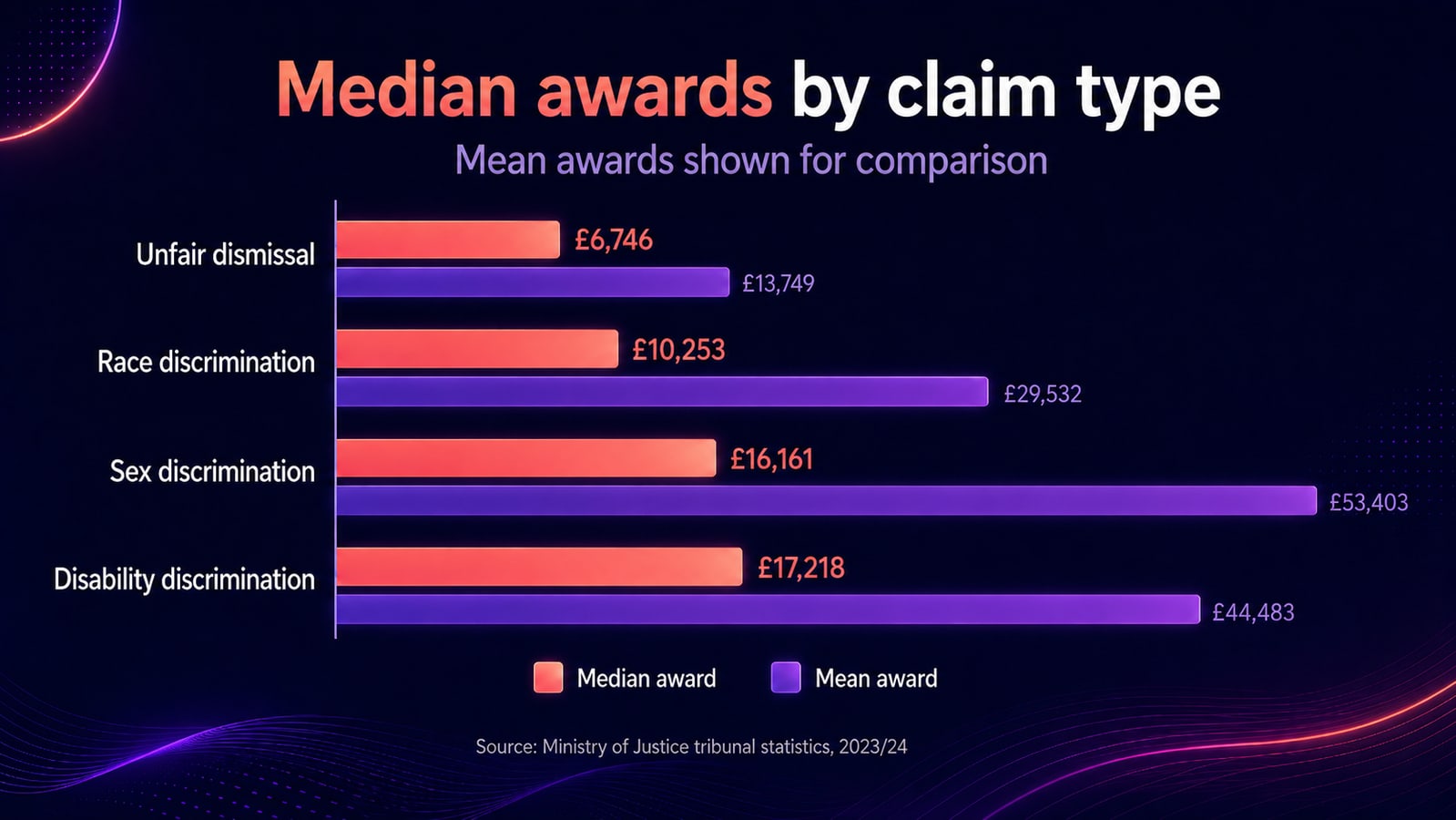
Two things to read carefully here.
The median is the honest number, not the mean. In each row the mean sits well above the median because a handful of very large awards drag it upwards. The highest single sex discrimination award in that year was £995,128. Almost nobody gets that, and quoting the mean as a typical outcome is misleading.
Discrimination claims are uncapped; unfair dismissal is not. For unfair dismissal, the compensatory award under section 123 of the Employment Rights Act 1996 is capped at the lower of 52 weeks' pay or £123,543 for dismissals on or after 6 April 2026, on top of a basic award capped at £22,530. Discrimination compensation under the Equality Act 2010 has no cap and adds an injury to feelings award on top of financial loss.
Compensation is also mostly about loss, not punishment. If you found an equivalent job quickly, the compensatory element is smaller, because you are compensated for what the dismissal cost you. The compensation guide sets out how the arithmetic works, and the claim value calculator gives an indicative range from your own figures.
When a claim may not be worth bringing
The genuinely useful version of this guide has to include the other side. A claim is a harder proposition when:
- The deadline has passed. Missing it almost always bars the claim outright, whatever its merits. Check the date first, using the tribunal deadlines guide.
- There is no documentary trail. Tribunals decide on evidence. A serious grievance with nothing in writing is much harder to run than a modest one with a paper record.
- The sum in dispute is small and the employer is defending. A few weeks' pay may not justify a year of process, though it may still be worth pursuing through ACAS.
- The employer is insolvent. A judgment against a company with no assets may not be recoverable, and different routes exist for some payments.
- What you want is your job back. A tribunal can order reinstatement or re-engagement after an unfair dismissal, but these orders are made rarely and cannot be physically enforced against an unwilling employer. Where one is not complied with, the outcome converts back into money in the form of an additional award.
- What you want is an apology or an admission. The tribunal awards compensation. In discrimination claims it can make a recommendation aimed at reducing the effect on you, but it cannot order an employer to say sorry. Negotiated settlements can include wording that a judgment cannot.
None of these are absolute. They are the factors that most often turn an arguable claim into a difficult one.
How to decide
A workable order of questions, in the order that actually matters:
- Am I in time? Everything else is academic if the answer is no.
- What can I prove, and with what? List the documents you already have, not the ones you wish you had.
- What is the realistic range? Use the claim type, your salary and your service, not the headline figures in the press.
- What is the process cost to me? A year of intermittent attention, and the emotional load of revisiting it.
- What would settlement have to look like for me to accept it? Deciding this early is what keeps a negotiation from drifting.
For what running it yourself actually involves, see going to tribunal without a solicitor; for the full range of support options and what each costs, see how to get employment tribunal help.
Key takeaway
The financial barrier to bringing an employment tribunal claim is low: there are no fees, and costs orders against ordinary claimants are rare. The real costs are time and attention, and the tribunal backlog has made both larger. Against that, most claims are resolved by negotiation rather than judgment, and the strength of a documented case is what gives that negotiation its weight. If you are in time and you can evidence what happened, starting the process usually keeps your options open; if you are out of time or have nothing in writing, that is the point to be honest with yourself about.
_This article is legal information, not legal advice. Award figures are from published MoJ tables and are historic; check the linked sources for the current position._
Sources used in this guide
- GOV.UK: Make a claim to an employment tribunal
- MoJ: Tribunal statistics quarterly, January to March 2026
- MoJ: Employment Tribunal and EAT statistics tables
- Employment Rights Act 1996 - Section 123 (compensatory award)
- Equality Act 2010 - Section 124 (remedies)
- Employment Tribunal Procedure Rules 2024 - Rule 74 (costs orders)
- ACAS: Early conciliation
Links to legislation.gov.uk, gov.uk, acas.org.uk and bills.parliament.uk are official sources. Always check the current version on the source site before relying on a specific point.
Frequently asked questions
Does it cost anything to bring an employment tribunal claim?
There is no fee to lodge a claim at the employment tribunal or to appeal to the Employment Appeal Tribunal. A fee of £55 was consulted on in 2024 but was not introduced. Your real costs are your time, any paid help you choose to use, and in rare cases a costs order if a claim is pursued unreasonably.
Will I have to pay my employer's legal costs if I lose?
Usually not. The employment tribunal is a costs-free jurisdiction as a general rule, so each side normally bears its own costs even when they lose. Costs orders are the exception and are aimed at conduct rather than outcome: bringing or conducting a claim vexatiously, abusively, disruptively or otherwise unreasonably, or pursuing a claim that had no reasonable prospect of success.
How much compensation do people actually get?
In the most recent published MoJ tables the median unfair dismissal award was £6,746 and the mean was £13,749, across 646 awards. Discrimination awards are uncapped and sit higher: the median disability discrimination award was £17,218 and the median sex discrimination award was £16,161. Medians matter more than means here, because a small number of very large awards pull the average up.
How long does an employment tribunal claim take?
Longer than it used to. At the end of March 2026 the single-claim open caseload stood at around 64,000, up 55% on March 2025, because claims are arriving faster than they are being resolved. The MoJ does not publish a mean time from claim to disposal for single claims, but in practice a contested claim can run well beyond a year from lodging to final hearing, and complex discrimination claims typically take longer than straightforward dismissal claims.
Is it worth it if I only want an apology?
An apology is not a remedy the tribunal can order. The tribunal awards compensation, and in discrimination claims it can make a recommendation aimed at reducing the effect of the discrimination on the claimant. If acknowledgement matters more than money, ACAS Early Conciliation and settlement discussions are where that is more commonly achieved, because the terms are negotiated rather than imposed.
Trying to work out whether your claim is worth pursuing?
Ari helps you build the case first - the events, the evidence and the likely range - so the decision rests on your own facts rather than a guess.
Build your case with AriOr use the free Employment claim value estimator.
Related guides
 Claims7 min read
Employment Tribunal Success Rate: What the 2025/26 Data Shows
Latest MoJ and Acas figures on employment tribunal success rates, claim volumes, settlements and waiting times - and what they really mean for your claim.
Read guide Claims9 min read
Employment Tribunal Compensation: How Awards Are Calculated
How employment tribunal compensation works: basic and compensatory awards, the statutory cap, Vento bands, uplifts, deductions and tax.
Read guide Process8 min read
How Much Does an Employment Tribunal Cost?
What an employment tribunal really costs: why there are no claim fees, what representation costs, when costs orders happen, and no-win-no-fee options.
Read guide Process11 min read
Going to Employment Tribunal Without a Solicitor
You can take your employer to tribunal without a solicitor. The stage-by-stage journey, bundle and witness statement, costs risk, and free help available.
Read guide Deadlines9 min read
Employment Tribunal Time Limits: 3 Months Less 1 Day, Explained
How UK employment tribunal time limits work - the 3 months less 1 day rule, trigger dates by claim type, how ACAS pauses the clock, and late claims.
Read guide Process7 min read
How to Get Employment Tribunal Help in England and Wales: Your Options Compared
Compare your options for employment tribunal help in England and Wales: solicitor, no-win-no-fee, self-representation, and self-serve case-building tools.
Read guide