Reasonable Adjustments at Work: Your Rights If Refused
This guide covers England and Wales. It is general information, not legal advice, and is not a substitute for advice about your own situation. Laws and figures change - always check the current position on GOV.UK before relying on any detail here.
When you are managing a disability or a health condition and work is making it harder than it needs to be, asking for help can feel strangely exposing - as if you are requesting special treatment rather than a fair chance. Maybe you have already asked and been brushed off, told it is "not possible," or left waiting so long you have started to doubt yourself. Where a change at work would remove a disadvantage you face because of a disability, your employer has a legal duty to make that change where it is reasonable - not as a favour, but as a matter of law. This guide explains what reasonable adjustments are, when the duty applies, and what you can do if your employer says no.
Disability discrimination is now one of the most common reasons people bring employment tribunal claims in England and Wales, and a large share of those claims come down to a single issue: an employer that would not make a reasonable adjustment. If you are disabled and your workplace, hours or duties put you at a disadvantage that a change could fix, your employer is under a legal duty to make that change - and refusing a reasonable one can be unlawful.
This guide focuses on the practical position of a worker who needs an adjustment; for the wider picture of disability as a protected characteristic and how it sits alongside the other forms of discrimination, see the workplace discrimination guide.
What are reasonable adjustments?
A reasonable adjustment is a change an employer makes so that a disabled person is not put at a substantial disadvantage compared with people who are not disabled. The duty comes from section 20 of the Equality Act 2010, and a failure to comply with it is itself a form of discrimination under section 21.
"Substantial" here means more than minor or trivial. The point of the duty is to level the playing field - not to give an advantage, but to remove a disadvantage that the disability, combined with how the job is arranged, would otherwise cause.
The duty is anticipatory in spirit but practical in operation: it bites in relation to the individual disabled worker and what they actually need, once the employer is on notice of the disadvantage.
When the duty applies
The duty arises in three situations under the Equality Act 2010. An employer must consider adjustments where:
- A provision, criterion or practice - a way the employer does things, such as a rule, a policy, or how shifts are allocated - puts a disabled worker at a substantial disadvantage.
- A physical feature of the workplace - steps, lighting, layout - puts them at a substantial disadvantage.
- The absence of an auxiliary aid - a piece of equipment or support, such as a screen reader or a support worker - puts them at a substantial disadvantage.
Crucially, the duty is only triggered once the employer knows, or could reasonably be expected to know, both that you are disabled and that you are at a substantial disadvantage. That is why getting your condition and its effects in writing matters so much - it closes off any later argument that the employer did not realise.
Whether your condition counts as a disability turns on the Equality Act test - a physical or mental impairment with a substantial and long-term adverse effect on normal day-to-day activities, including many mental health conditions. The workplace discrimination guide sets out that definition in full, so it is not repeated here.
What counts as "reasonable"?
The employer only has to make adjustments that are reasonable, and reasonableness is judged objectively. Tribunals have typically weighed factors such as:
- how effective the adjustment would be in removing the disadvantage
- how practical it is to make
- the cost, and the disruption involved
- the employer's size and financial resources
- the availability of outside help, such as Access to Work funding
Cost on its own is rarely a complete defence for a larger, well-resourced employer, particularly where the adjustment is inexpensive and clearly effective. A small business with very limited means is in a different position - but it still has to engage with the request rather than dismiss it out of hand.
Common examples of reasonable adjustments
What is reasonable is fact-specific, but adjustments that have been made in similar situations include:
- changing working hours or allowing flexible or remote working
- a phased return to work after sickness absence
- providing specialist equipment, software or an ergonomic workstation
- allowing additional or more frequent breaks
- reallocating minor duties that cause particular difficulty
- adjusting or relaxing performance targets during a period of ill health
- moving someone to a more suitable role or location
The right adjustment is the one that addresses your specific disadvantage - there is no fixed list, and an employer cannot refuse simply because a change is unusual.
How to request a reasonable adjustment
You do not have to use any magic words or even the phrase "reasonable adjustment" - but putting the request in writing is sensible, because it creates a clear record of what you asked for and when. In similar situations, a clear request tends to set out:
- your condition and that it amounts to a disability (without needing a formal diagnosis label)
- the specific difficulty or disadvantage you are experiencing at work
- the adjustment you are asking for, and how it would help
Asking your employer to obtain an occupational health assessment is often a constructive step - it produces an independent view of what you need and makes it far harder for the employer to claim ignorance of the disadvantage.
What to do if your employer refuses
A refusal, or a long silence, is not the end of the road. The steps taken in similar situations tend to follow a clear order:
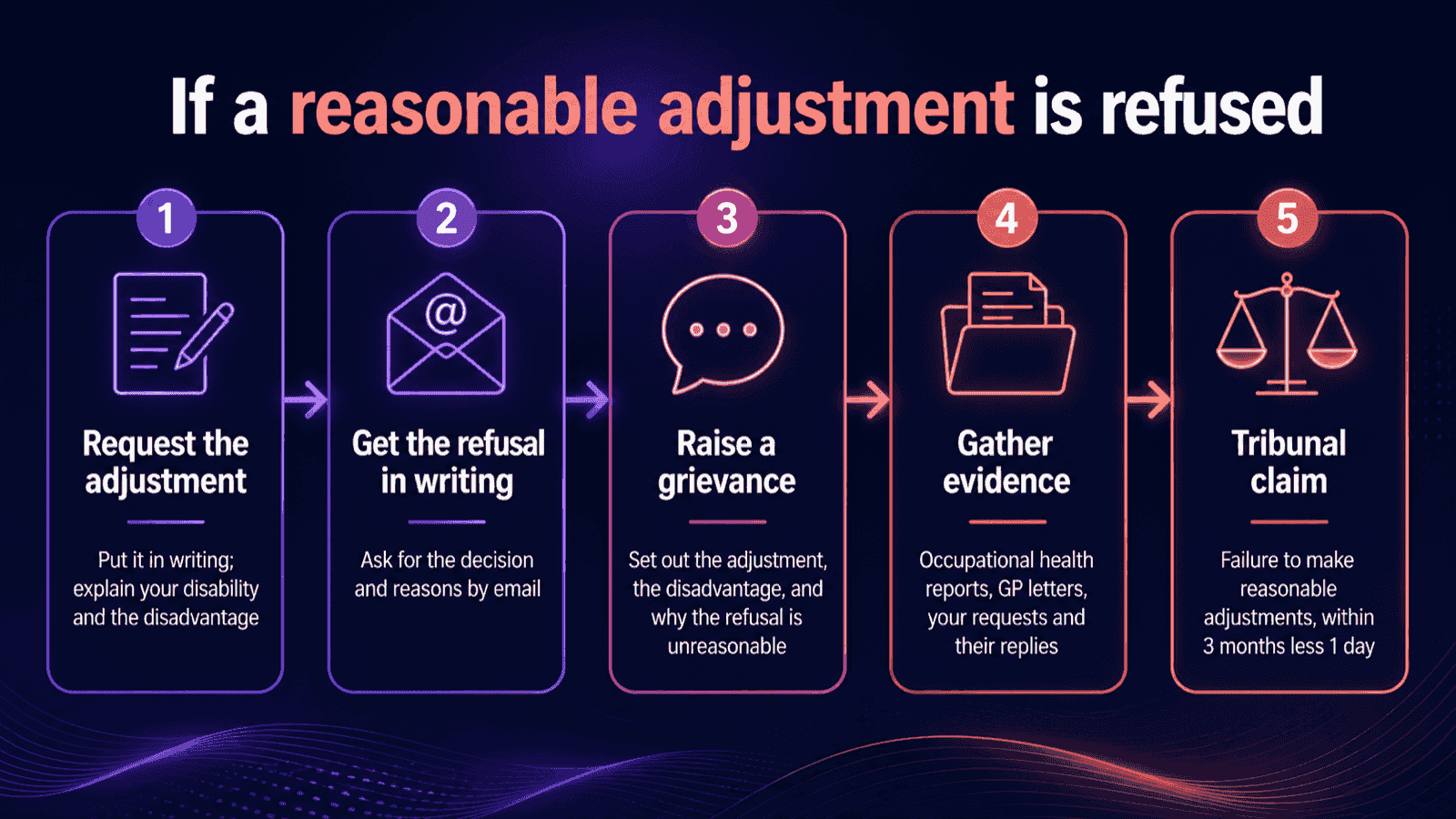
- Get the refusal in writing. Ask for the decision and the reasons in an email if they have only been given verbally. This pins down what was refused and why.
- Raise a formal grievance. Set out the adjustment, the disadvantage it would remove, and why you say the refusal is unreasonable. A grievance engages the ACAS Code and often produces written reasons that become useful evidence. The grievance letter guide covers what to include.
- Build your evidence. Keep occupational health reports, GP or specialist letters, your written requests, and the employer's responses. Contemporaneous evidence - created at the time - carries far more weight than recollections later.
- Consider a tribunal claim if the grievance does not resolve it.
Bringing a tribunal claim
A claim for failure to make reasonable adjustments is a disability discrimination claim under the Equality Act 2010. Two features matter especially:
There is no qualifying period. Unlike most unfair dismissal claims, you do not need two years' service - the protection applies from day one of employment.
The time limit is strict. A discrimination claim must generally be started within 3 months less 1 day of the act complained of - here, the failure to make the adjustment. Working out the right date when a refusal is ongoing can be genuinely difficult, so calculate it carefully and start ACAS Early Conciliation well before it expires. The employment tribunal deadlines guide explains how the timing works.
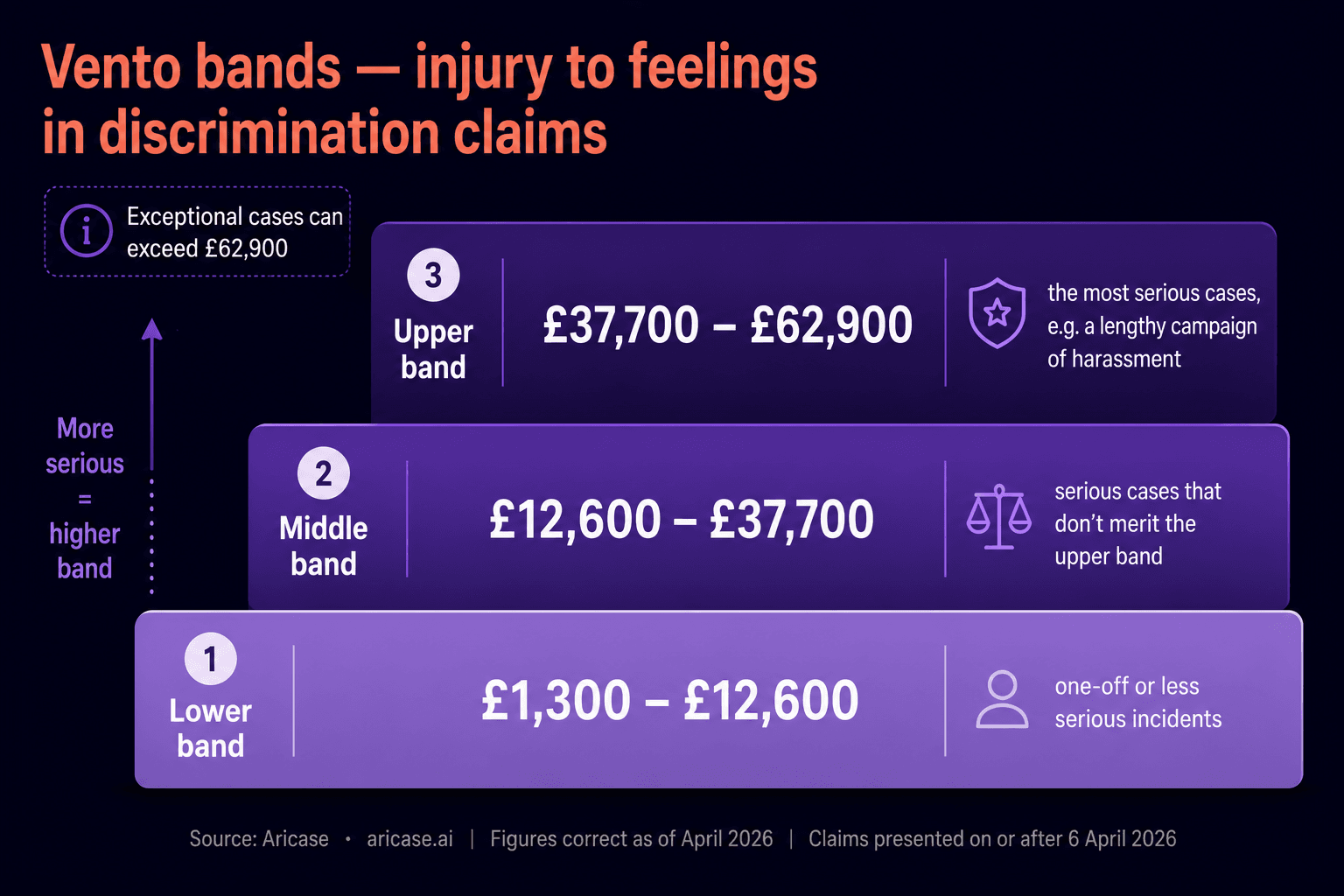
If a claim succeeds, compensation for disability discrimination is uncapped - there is no statutory ceiling of the kind that limits ordinary unfair dismissal awards. It can include financial losses and an injury to feelings award under the Vento bands. How those awards are valued is set out in the compensation guide.
Key takeaway
If a change at work would remove a disadvantage your disability causes, your employer has to give it serious, reasoned consideration - not refuse out of habit or cost alone. Put your request and the disadvantage in writing, ask for occupational health input, and if you are refused, raise a grievance and keep every document. Those records are what turn a refusal into a claim a tribunal can act on - and because the compensation is uncapped, getting the case built and checked properly is worth the care. Calculate your deadline early: the 3-months-less-1-day limit is strict, and it is the one thing a strong case cannot survive missing.
This article is legal information, not legal advice. The Equality Act figures and the Vento band ranges change regularly - always check the current position with GOV.UK, ACAS and the EHRC before relying on it.
Sources used in this guide
- Equality Act 2010 - Section 20 (duty to make adjustments)
- Equality Act 2010 - Section 21 (failure to comply with the duty)
- ACAS - Reasonable adjustments at work
- Equality and Human Rights Commission - Reasonable adjustments for disabled workers
Links to legislation.gov.uk, gov.uk, acas.org.uk and bills.parliament.uk are official sources. Always check the current version on the source site before relying on a specific point.
Frequently asked questions
What are reasonable adjustments at work?
They are changes an employer must make under the Equality Act 2010 so that a disabled worker is not placed at a substantial disadvantage compared with non-disabled colleagues. Examples include changing working hours, providing specialist equipment, allowing more breaks, or adjusting performance targets during a period of ill health.
Can my employer refuse a reasonable adjustment?
An employer can decline an adjustment that is not reasonable - reasonableness depends on factors such as cost, how effective the change would be, and the size and resources of the employer. But refusing an adjustment that is reasonable, where the duty applies, is unlawful and can be the basis of a tribunal claim. Cost alone is rarely a complete answer for a larger employer.
Does my employer have to know I am disabled?
The duty is triggered once the employer knows, or could reasonably be expected to know, both that you are disabled and that you are at a substantial disadvantage. This is why putting your condition and the difficulty it causes in writing matters - it removes any argument that they did not know.
What can I do if my employer refuses reasonable adjustments?
Put the request and the refusal in writing, raise a formal grievance setting out the adjustment and the disadvantage, and gather evidence such as occupational health reports and GP letters. If the grievance does not resolve it, you can bring a failure to make reasonable adjustments claim at an employment tribunal, normally within three months less one day.
How much compensation can I get for failure to make reasonable adjustments?
Compensation for disability discrimination, including failure to make reasonable adjustments, is uncapped. It can cover financial losses and an injury to feelings award under the Vento bands. Because there is no statutory ceiling, awards can be higher than in an ordinary unfair dismissal claim.
Has your employer refused an adjustment you need?
Aricase helps you document your request, what happened when it was refused, and the disadvantage it caused - and build a case that a specialist then checks.
Start your 7-day free trialOr explore our free employment law calculators.
Related guides
 Claims11 min read
Workplace Discrimination: Your Rights Under the Equality Act 2010
A plain-English guide to workplace discrimination in the UK: the 9 protected characteristics, the types of discrimination, compensation, and how to claim.
Read guide Deadlines9 min read
Employment Tribunal Time Limits: 3 Months Less 1 Day, Explained
How UK employment tribunal time limits work - the 3 months less 1 day rule, trigger dates by claim type, how ACAS pauses the clock, and late claims.
Read guide Process10 min read
Employment Tribunal Evidence: A Complete Guide
What counts as evidence at an employment tribunal, how to gather it, how a trial bundle works, and what to do if your employer withholds documents.
Read guide Claims9 min read
Employment Tribunal Compensation: How Awards Are Calculated
How employment tribunal compensation works in England and Wales: basic and compensatory awards, the statutory cap, Vento bands, uplifts, deductions and tax.
Read guide Documents9 min read
How to Write a Workplace Grievance Letter
A plain English guide to writing a formal grievance letter in the UK - what to include, where to send it, and how it affects your employment tribunal claim.
Read guide