Workplace Discrimination: Your Rights Under the Equality Act 2010
This guide covers England and Wales. It is general information, not legal advice, and is not a substitute for advice about your own situation. Laws and figures change - always check the current position on GOV.UK before relying on any detail here.
Being treated worse at work because of who you are - your race, your sex, your age, a disability, your faith - lands differently from an ordinary workplace problem. It can make you second-guess yourself, replay conversations wondering if you read them right, and feel as though you would have to prove something other people can see but will not say out loud. You are not imagining the pattern, and naming it is not "playing the victim." The Equality Act 2010 gives you real protection from your first day at work, and this guide explains what the law recognises as discrimination, the forms it takes, and the steps that, in similar situations, have helped people protect their position.
Workplace discrimination is one of the most common reasons people bring employment tribunal claims in England and Wales. The law gives strong protections, and unlike unfair dismissal, there is no qualifying period - it applies from your first day at work.
What is workplace discrimination?
Workplace discrimination means being treated unfairly at work because of a characteristic that is protected under the Equality Act 2010. The Act covers not just dismissal but a wide range of treatment - from recruitment decisions and pay to promotions, working conditions, and how disciplinary processes are handled.
The most important thing to understand is that no qualifying period applies. You do not need to have worked for your employer for 2 years. A discrimination claim can be brought from your first day of employment - or even before employment starts, if you were treated unfairly during a job application or interview because of a protected characteristic.
What are the 9 protected characteristics?
The Equality Act 2010 sets out 9 protected characteristics. Treatment connected to any of these can form the basis of a discrimination claim.
Age covers people of all ages - not just older workers. An employer who refuses to hire someone because they are considered "too old" or "too young" may be acting unlawfully.
Disability includes physical and mental health conditions that have a substantial and long-term adverse effect on the ability to carry out normal day-to-day activities. Mental health conditions such as depression, anxiety, PTSD, and bipolar disorder can qualify. Some conditions - including cancer, HIV infection, and multiple sclerosis - are automatically treated as disabilities from the point of diagnosis.
Gender reassignment protects people who are proposing to undergo, are undergoing, or have undergone a process of gender reassignment. You do not need to have had any medical treatment for this protection to apply.
Marriage and civil partnership provides more limited protection than the other characteristics. It applies to the workplace but not to recruitment. It covers treatment connected to the fact of being married or in a civil partnership, not to relationships generally.
Pregnancy and maternity protects against unfavourable treatment connected to pregnancy or maternity leave. This applies during the protected period, which runs from the start of pregnancy through to the end of maternity leave.
Race covers colour, nationality, and ethnic or national origins. It can include national origin (such as being English, Welsh, Scottish, or Irish), ethnicity, or membership of a particular racial group.
Religion or belief covers religion, religious belief, and philosophical belief - including a lack of belief. Philosophical belief must meet certain criteria to qualify: it must be genuinely held, concern a weighty matter, have a level of cogency and coherence, and be worthy of respect in a democratic society.
Sex protects both men and women from treatment that is less favourable because of their sex.
Sexual orientation covers gay, lesbian, bisexual, and heterosexual people. It refers to orientation towards people of the same sex, the opposite sex, or both.
What are the types of discrimination?
The Equality Act 2010 recognises several distinct types of discrimination. Understanding which applies to your situation matters because the legal tests are different.
Direct discrimination
Direct discrimination happens when someone is treated less favourably because of a protected characteristic than someone without that characteristic would be treated in the same or similar circumstances. A typical example is an employer who does not promote a woman because she is pregnant, or who does not shortlist a candidate because of their ethnic background.
The comparator does not need to be a real person. A tribunal can consider how a hypothetical comparator - someone without the relevant characteristic but in otherwise similar circumstances - would have been treated.
Indirect discrimination
Indirect discrimination arises when a provision, criterion, or practice applies equally to everyone but puts people with a particular protected characteristic at a particular disadvantage compared to those without it. If the employer cannot show that the provision was a proportionate means of achieving a legitimate aim, it is unlawful.
An example might be a requirement that all employees work full-time hours. That requirement applies to everyone, but it may put women at a particular disadvantage because women are statistically more likely to have childcare responsibilities. Whether it is justified depends on whether the employer can show a genuine business need that outweighs the disadvantage caused.
Harassment
Harassment under the Equality Act 2010 is unwanted conduct related to a protected characteristic that has the purpose or effect of violating a person's dignity, or creating an intimidating, hostile, degrading, humiliating, or offensive environment. The effect is judged partly from the perspective of the person affected - the law does not require the perpetrator to have intended to cause harm.
Harassment does not have to come from an employer. It can involve colleagues, clients, or customers. Employers can be liable if they failed to take reasonable steps to prevent it.
Victimisation
Victimisation means being treated badly because you made or supported a complaint about discrimination, or because you did something else protected under the Equality Act 2010 - such as giving evidence in someone else's discrimination case. The law protects people who raise these issues in good faith.
How does disability discrimination work?
Disability discrimination deserves separate attention because the law gives disabled people additional protections that go beyond the four types described above.
Direct disability discrimination works in the same way as direct discrimination for other characteristics. An employer who refuses to promote someone because of a disability is acting unlawfully.
Failure to make reasonable adjustments is a duty that exists specifically for disability. If a provision, criterion, practice, or physical feature puts a disabled person at a substantial disadvantage compared to non-disabled people, the employer is under a duty to take reasonable steps to remove that disadvantage. What counts as reasonable depends on factors including the cost of the adjustment, the size of the employer, and the practicality of the change. Examples include changing a disabled employee's hours, providing specialist equipment, or adjusting performance targets during a period of ill health. The reasonable adjustments guide covers how to request one and what to do if your employer refuses.
Discrimination arising from disability is a separate type of claim. It arises when someone is treated unfavourably not because of the disability itself but because of something that arises from or is connected to it. A common example is dismissing an employee because of a high level of sickness absence, where that absence was caused by a disability. The employer has a defence if they can show the treatment was a proportionate means of achieving a legitimate aim, or if they did not know and could not reasonably have been expected to know that the person was disabled.
What "substantial and long-term" means
To qualify as a disability under the Equality Act 2010, an impairment must have a substantial and long-term adverse effect on normal day-to-day activities. "Substantial" means more than minor or trivial. "Long-term" generally means that the effect has lasted at least 12 months, is expected to last at least 12 months, or is expected to last for the rest of the person's life.
An impairment that comes and goes can still qualify if it is likely to recur. A condition that is controlled by medication is assessed as if the medication were not being taken - so a condition that is well-managed but would cause substantial effects without treatment still counts. The tribunal will look at the overall picture, not just whether the person is symptomatic on any particular day.
Do you need a qualifying period to claim discrimination?
This point cannot be overstated. Discrimination claims are different from unfair dismissal claims in one fundamental way: there is no minimum period of employment required. The 2-year qualifying period that applies to most unfair dismissal claims does not apply here.
This means that someone who is dismissed in their first week of employment - or even refused a job in the first place - can bring a discrimination claim if the treatment was connected to a protected characteristic. It also means that even if you do not have 2 years' service and cannot bring an unfair dismissal claim, you may still have a strong legal claim if discrimination is involved.
How much compensation can you get for discrimination?
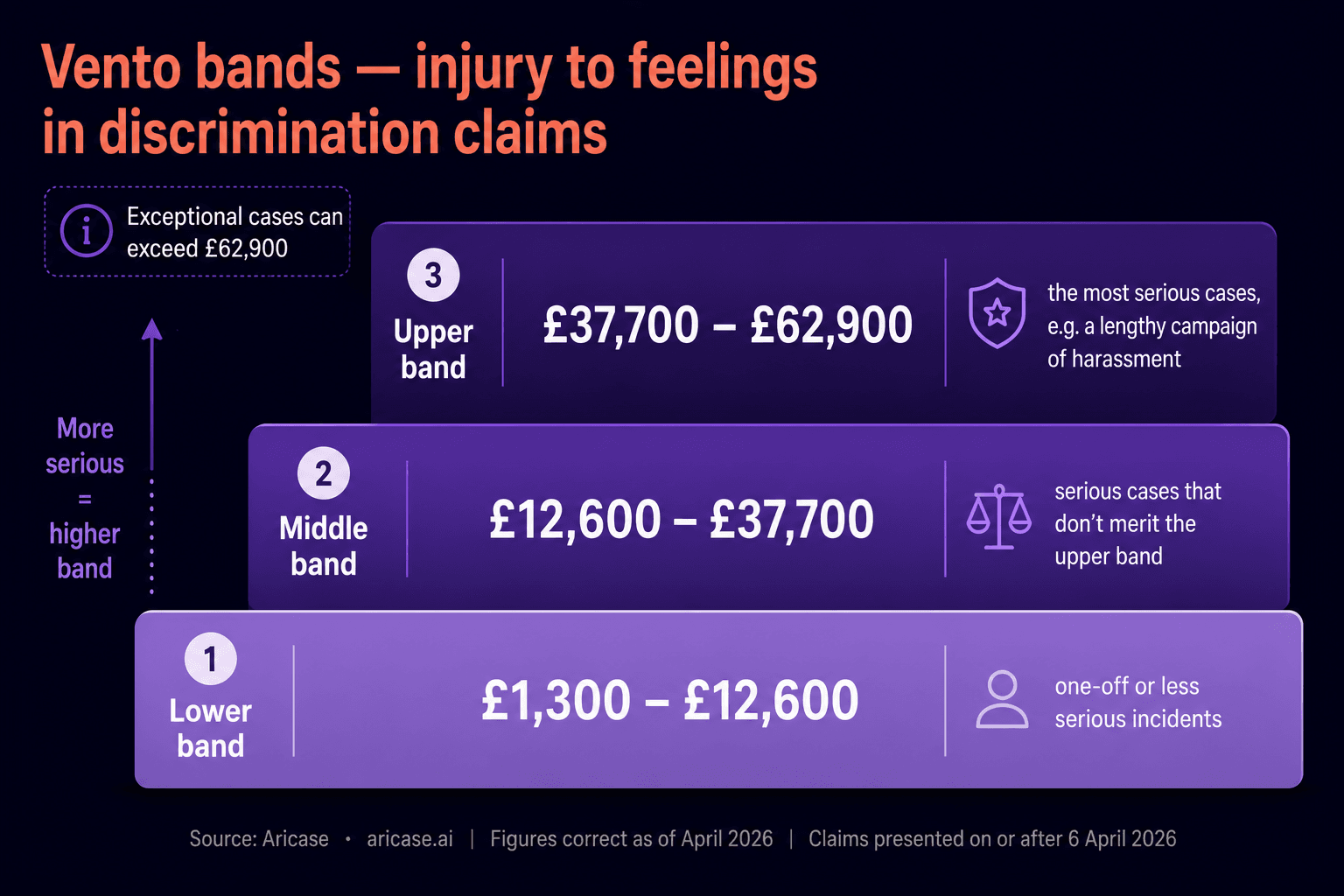
Compensation for discrimination is uncapped. There is no statutory ceiling on what a tribunal can award. This contrasts with the basic and compensatory awards for ordinary unfair dismissal, which are subject to statutory limits.
Awards in discrimination cases typically cover three things. First, financial losses - past earnings lost as a result of the discrimination, and future losses if the claimant has not yet found equivalent work. Second, injury to feelings - an award to reflect the distress caused by the discrimination. These are assessed by reference to the Vento bands, which set three tiers depending on the seriousness of the conduct. In more serious cases, the top Vento band applies - for claims presented on or after 6 April 2026 that band runs from £37,700 to £62,900 for the injury to feelings element alone, with the most exceptional cases capable of exceeding £62,900. Third, in the most serious cases, personal injury damages may be awarded where the discrimination has caused a recognised psychiatric illness.
Tribunals have also awarded aggravated damages in cases where the employer's conduct was particularly high-handed, malicious, or oppressive. Interest can be added to injury to feelings awards and past financial losses.
What is the deadline to bring a discrimination claim?
The deadline for bringing a discrimination claim is 3 months less 1 day from the act of discrimination, or from the last act in a continuing series of discriminatory acts. This is a strict deadline.
Before you can bring a claim at an employment tribunal, you must go through ACAS Early Conciliation. That process stops the clock while it is running, but you must start it before your 3-month deadline expires. See the employment tribunal deadlines guide and the ACAS Early Conciliation guide for detail on how the timing works.
If there is a continuing course of discriminatory conduct, the 3-month period runs from the last act in that course. However, it is safer not to rely on this. If you have a specific incident in mind, calculate the deadline from that incident and act promptly. Tribunals have discretion to extend the time limit where it is just and equitable to do so, but that discretion is not exercised generously - it is not a reliable safety net.
Who has the burden of proof in a discrimination claim?
Under section 136 of the Equality Act 2010, the burden of proof in discrimination cases is split. The claimant must first show facts from which a tribunal could conclude, in the absence of any other explanation, that discrimination occurred. This is sometimes described as establishing a prima facie case.
Once the claimant has done that, the burden shifts to the employer to show that the treatment had nothing to do with the protected characteristic. This burden-shifting mechanism means that claimants do not need to prove discrimination on the balance of probabilities from the outset - but they do need to point to real, credible facts. A tribunal that finds those facts proved but receives no satisfactory explanation from the employer must find discrimination.
This makes contemporaneous evidence - emails, messages, documents created at the time - particularly important. If the employer later offers a different reason for treatment that looks discriminatory, a paper trail from before the dispute arose is far more persuasive than explanations given after the event.
What can you do if you have been discriminated against?
The steps taken in similar situations tend to follow a clear pattern. Gather evidence as soon as possible - emails, messages, performance reviews, meeting notes, CCTV if relevant, and accounts from any witnesses. Evidence degrades quickly, and contemporaneous notes are far more persuasive to a tribunal than recollections made months later.
Consider raising a formal grievance with your employer. A grievance creates a paper trail, engages the ACAS Code of Practice on Disciplinary and Grievance Procedures, and can produce responses from the employer that are useful as evidence. Not raising a grievance does not bar a discrimination claim, but tribunals can adjust compensation where a party has unreasonably failed to follow the ACAS Code. See the how to write a grievance letter guide for practical guidance on what to include.
Calculate your 3-month deadline carefully from the act or last act of discrimination, then start ACAS Early Conciliation before it expires. See the ACAS Early Conciliation guide for how that process works.
Can you bring discrimination alongside other claims?
Discrimination claims can run alongside other types of employment tribunal claim. Someone who is dismissed for a discriminatory reason may be able to bring both a discrimination claim and, if they have 2 years' service, an unfair dismissal claim at the same time.
Where the dismissal is found to be both unfair and discriminatory, the tribunal assesses compensation on the discrimination basis - which means the award is uncapped. The two claims are not simply added together, but running them together ensures the strongest basis for compensation is put before the tribunal.
See the unfair dismissal guide for more detail on how that claim works and how the two can interact.
Sources used in this guide
- Equality Act 2010
- Equality Act 2010 - Burden of proof (s.136)
- ACAS - Discrimination and the law
- GOV.UK - Discrimination: your rights
- Equality and Human Rights Commission - Your rights under the Equality Act 2010
Links to legislation.gov.uk, gov.uk, acas.org.uk and bills.parliament.uk are official sources. Always check the current version on the source site before relying on a specific point.
Frequently asked questions
Do I need 2 years' service to claim discrimination?
No. There is no qualifying period for discrimination claims. You can bring a claim from your very first day of employment, and even during a recruitment process if you were treated unfairly because of a protected characteristic.
What are the 9 protected characteristics?
Age, disability, gender reassignment, marriage and civil partnership, pregnancy and maternity, race, religion or belief, sex, and sexual orientation. These are set out in the Equality Act 2010.
What is the difference between direct and indirect discrimination?
Direct discrimination is when someone is treated less favourably because of a protected characteristic - for example, not being promoted because of your religion. Indirect discrimination is when a rule or policy applies to everyone but puts people with a particular protected characteristic at a disadvantage - for example, a blanket policy that indirectly disadvantages people of a certain ethnicity.
Is harassment at work the same as discrimination?
Harassment is a separate type of unlawful conduct under the Equality Act 2010, but it is closely related to discrimination. It covers unwanted conduct related to a protected characteristic that violates dignity or creates an intimidating, hostile, degrading, humiliating, or offensive environment. You can bring a harassment claim even if you cannot show you were treated less favourably than someone else.
How much compensation can I get for workplace discrimination?
Compensation for discrimination is uncapped. Awards can include financial losses (lost earnings, future losses), injury to feelings under the Vento bands (for claims presented on or after 6 April 2026, ranging from around £1,300 in the lowest cases up to £62,900 at the top of the upper band, depending on severity), and in serious cases, damages for personal injury. The uncapped nature of discrimination compensation is one of the key differences from ordinary unfair dismissal.
What counts as a disability under the Equality Act?
A disability is a physical or mental impairment that has a substantial and long-term adverse effect on normal day-to-day activities. 'Long-term' generally means it has lasted or is likely to last 12 months or more. Mental health conditions such as depression and anxiety can qualify. Some conditions, including cancer, HIV, and multiple sclerosis, are deemed disabilities from diagnosis.
Think you have a discrimination claim?
Aricase helps you understand your position, organise your evidence, and build your case - without needing a solicitor from day one.
Start your 7-day free trialOr use the free Employment claim value estimator.
Related guides
 Claims8 min read
Pregnancy and Maternity Discrimination: Your Rights at Work
What pregnancy and maternity discrimination means under the Equality Act 2010: the protected period, your day-one rights, redundancy protection, and claims.
Read guide Claims9 min read
Reasonable Adjustments at Work: Your Rights If Refused
Reasonable adjustments at work explained: what your employer must do under the Equality Act 2010, what counts as reasonable, and how to claim if they refuse.
Read guide Claims11 min read
Unfair Dismissal in the UK: Do You Have a Claim?
Plain-English guide to UK unfair dismissal: what counts, who can claim, time limits, and what compensation looks like at an employment tribunal.
Read guide Rights9 min read
Bullying and Harassment at Work: Legal Options
Bullying and harassment at work explained for England and Wales - why bullying alone is not a claim, when harassment is unlawful, and the routes you can take.
Read guide Claims9 min read
Employment Tribunal Compensation: How Awards Are Calculated
How employment tribunal compensation works in England and Wales: basic and compensatory awards, the statutory cap, Vento bands, uplifts, deductions and tax.
Read guide Documents9 min read
How to Write a Workplace Grievance Letter
A plain English guide to writing a formal grievance letter in the UK - what to include, where to send it, and how it affects your employment tribunal claim.
Read guide Claims7 min read
Employment Tribunal Success Rate: What the 2025/26 Data Shows
Latest MoJ and Acas figures on employment tribunal success rates, claim volumes, settlement rates and waiting times - and what they really mean for your claim.
Read guide