The Employment Tribunal Process, Step by Step: What Happens and When
This guide covers England and Wales. It is general information, not legal advice, and is not a substitute for advice about your own situation. Laws and figures change - always check the current position on GOV.UK before relying on any detail here.
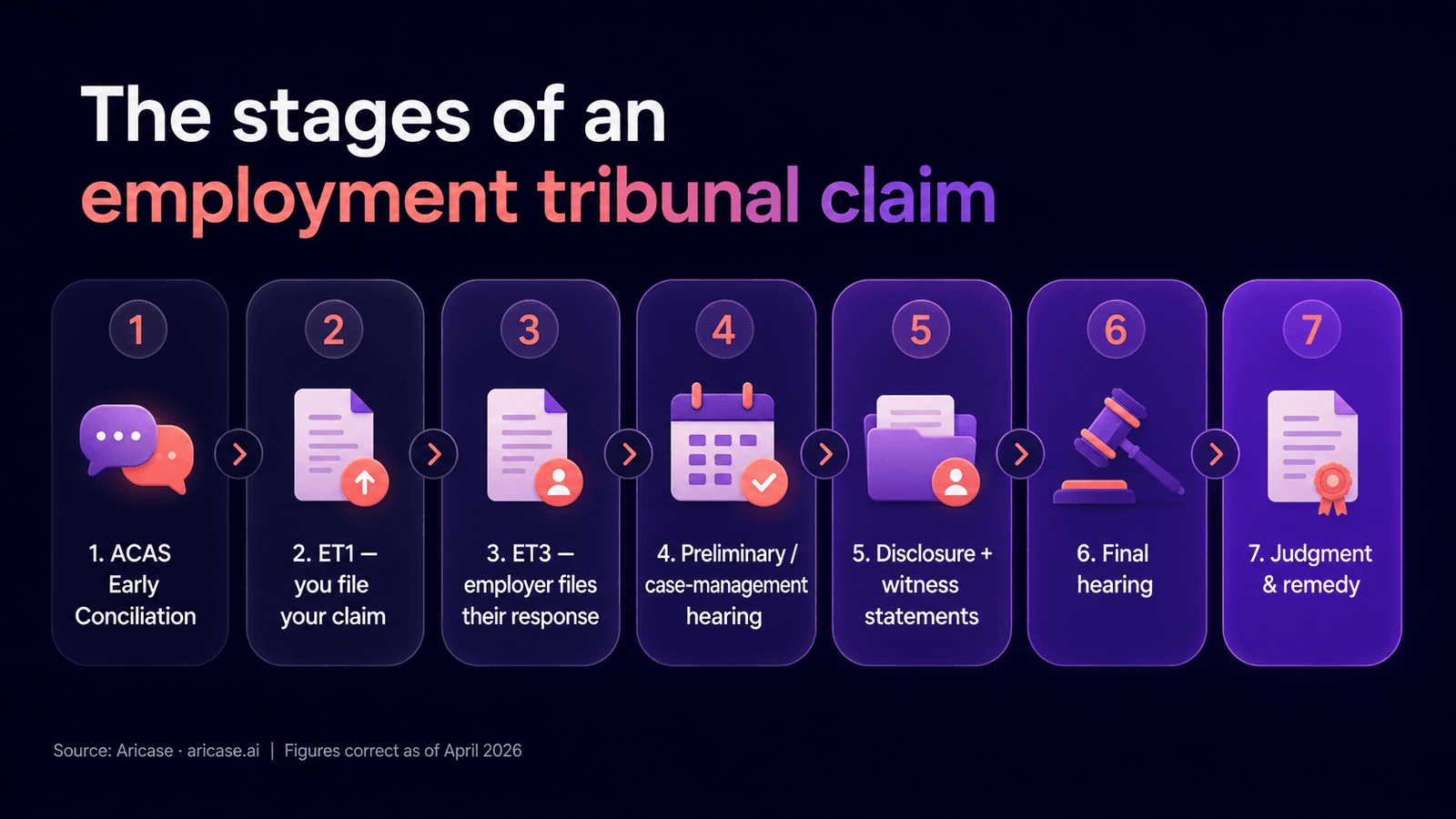
Knowing the order of events takes a lot of the fear out of an employment tribunal claim. The process in England and Wales follows a fixed sequence set out in the Employment Tribunal Procedure Rules 2024, and while the timing of each stage varies, the stages themselves rarely change. This guide walks through the whole journey, from the first contact with ACAS to the judgment, and gives a realistic sense of how long each part typically takes.
The timeline above is the spine of the process. The sections below explain what actually happens at each stage, and link to the in-depth guides for the steps that deserve a closer look.
Before the claim: ACAS Early Conciliation
For most claims, the journey does not start at the tribunal at all - it starts with ACAS. Under section 18A of the Employment Tribunals Act 1996, you must notify ACAS and go through Early Conciliation before you can issue a claim. A small number of claim types are exempt, but most people have to take this step.
Early Conciliation is a free, confidential attempt to settle the dispute without a hearing. A conciliator contacts both sides to see whether an agreement is possible. For cases notified to ACAS on or after 1 December 2025, the process can run for up to 12 weeks (SI 2025/1153). It can end sooner if both sides agree there is nothing to discuss. Crucially, contacting ACAS pauses your tribunal time limit while conciliation runs, and you receive a certificate at the end with a reference number you need to bring a claim. The ACAS Early Conciliation guide explains this stage in full.
Starting the claim: the ET1
If conciliation does not resolve things, you start the claim by submitting form ET1 to the tribunal. This sets out who you are claiming against, what happened, and what you are claiming. The ET1 claim form guide walks through completing it.
The single most important thing at this stage is the deadline. For most claims the current time limit is 3 months less 1 day from the event you are complaining about, though the Employment Rights Act 2025 is expected to extend this to 6 months for most claims (targeted for around October 2026, but not yet in force and dependent on commencement regulations - breach of contract claims are expected to stay at 3 months). Because the exact date depends on your circumstances and the rules are changing, work out your own deadline with the tribunal deadline calculator and read the employment tribunal deadlines guide rather than relying on a general figure. Missing the deadline almost always bars the claim.
The employer responds: the ET3
Once your claim is accepted, the tribunal sends a copy to the employer (the respondent). Under the 2024 Procedure Rules, the respondent has 28 days from the date the tribunal sent the claim to file their response on form ET3. So if the tribunal sent the claim on 1 October, the response is due by 29 October.
The ET3 sets out which parts of the claim the employer accepts or disputes and the grounds of their defence. If no response is filed in time, the tribunal can decide the claim without one.
Getting the case ready: case management
With both sides' positions on the table, the tribunal sets directions for how the case will be prepared. This may happen on paper, or at a preliminary hearing - a short, usually private hearing to sort out practical matters, narrow the issues, or decide a preliminary point such as whether a claim was brought in time. Not every case has one.
The directions (often called case management orders) set the timetable for the next stages and fix the date of the final hearing. From here, preparation runs to that timetable.
Building the evidence: disclosure, bundle and witness statements
This is where most of the work happens, and it follows the tribunal's orders:
- Disclosure of documents. Both sides exchange the documents relevant to the case - good and bad - so that nothing relevant is hidden. The employment tribunal evidence guide explains what this involves.
- The hearing bundle. The relevant documents are compiled into a single agreed, paginated bundle that everyone, including the judge, works from at the hearing.
- Witness statements. Each side writes the written evidence of its witnesses and the statements are exchanged, usually simultaneously, before the hearing.
There is no fixed statutory clock for these steps - they run to the dates the tribunal sets, which is why staying on top of the orders matters.
The final hearing and judgment
At the final hearing, an employment judge (sometimes sitting with two non-legal panel members) hears the evidence. Witnesses give their evidence and are cross-examined, both sides make their arguments, and the tribunal decides whether the claim succeeds. Remedy - usually compensation - may be decided at the same hearing or at a separate one. The guide to what happens at the hearing covers the day itself in detail.
The wait for a final hearing date is often the longest part of the whole process, and tribunal backlogs mean it is frequently a year or more from the ACAS notification before a case is heard.
How long does the whole process take?
Putting the stages together, a claim that goes all the way to a final hearing commonly takes well over a year. Early Conciliation alone can take up to 12 weeks, the response and case management stages add a few months, and the hearing itself is usually scheduled many months further out. The tribunal statistics guide shows current waiting times and outcomes.
It is worth keeping in mind that most claims never reach a final hearing - they settle through ACAS or a settlement agreement, or are withdrawn, at some point along the way. The full sequence above is the map; many journeys end before the last stop. For a broader overview of what a tribunal is and the types of claim it hears, see the employment tribunal hub guide, and if you are weighing up representing yourself, the tribunal without a solicitor guide walks through doing it alone, and our guide comparing your options for tribunal help weighs up which suits which kind of claim.
This article is legal information, not legal advice. Tribunal procedure and time limits change - the Employment Rights Act 2025 reforms in particular take effect on different dates - so always check the current position on GOV.UK and with ACAS, and verify your own deadline before relying on any timescale here.
Sources used in this guide
- Employment Tribunal Procedure Rules 2024 (SI 2024/1155)
- Employment Tribunals (Early Conciliation: Exemptions and Rules of Procedure) (Amendment) Regulations 2025 (SI 2025/1153)
- Employment Tribunals Act 1996, section 18A (duty to contact ACAS before a claim)
- ACAS: How early conciliation works
- ACAS: Employment Rights Act 2025
- GOV.UK: Make a claim to an employment tribunal
Links to legislation.gov.uk, gov.uk, acas.org.uk and bills.parliament.uk are official sources. Always check the current version on the source site before relying on a specific point.
Frequently asked questions
How long does an employment tribunal take from start to finish?
It varies widely, but claims that reach a final hearing commonly take well over a year from the date you contact ACAS. Early Conciliation can run for up to 12 weeks, the response and case management stages take a few months, and there is then often a long wait for a hearing date because of tribunal backlogs. The published tribunal statistics give a realistic picture of current waiting times.
What happens after I submit the ET1 claim form?
The tribunal sends a copy of your ET1 to the employer, who then has 28 days from the date it was sent to file their response on form ET3. After that the tribunal sets directions for how the case will be prepared - sometimes at a preliminary hearing - covering disclosure of documents, the hearing bundle, witness statements and the final hearing date.
Do I have to go through ACAS before claiming?
For most claims, yes. Early Conciliation through ACAS is a mandatory first step and you cannot issue a tribunal claim without an ACAS certificate number, although a small number of claim types are exempt. Contacting ACAS also pauses your tribunal time limit while conciliation runs.
Can the timeline be paused or extended?
Yes. Early Conciliation pauses the tribunal time-limit clock while it runs. During the case itself the tribunal can extend deadlines, postpone hearings and give further directions. Final hearing dates also move when the tribunal lacks capacity, which is a common cause of delay.
Do most claims reach a final hearing?
No. The large majority of employment tribunal claims settle through ACAS or a settlement agreement, or are withdrawn, before they ever reach a final hearing. The full step-by-step process below is what happens in the cases that do go the distance.
Working out where you are in the process?
Aricase helps you build your employment case stage by stage - from the facts and your evidence through to what to expect at each step - with a specialist checking your case along the way.
Build your case with AriOr use the free Employment tribunal deadline calculator.
Related guides
 Process9 min read
Employment Tribunal: How Claims Work in England and Wales
What an employment tribunal is, the claims it hears, how a case runs from ACAS to the final hearing, deadlines and compensation - a plain-English guide.
Read guide Process6 min read
ACAS Early Conciliation: How It Works, Step by Step
What ACAS Early Conciliation is, why it is mandatory before an employment tribunal claim, and what to expect at each stage of the process.
Read guide Documents10 min read
How to Fill In Your ET1 Employment Tribunal Claim Form
How to fill in the ET1 claim form, section by section: the respondent, the claim narrative, the remedy section, and the mistakes that sink cases.
Read guide Process10 min read
What Happens at an Employment Tribunal Hearing
What happens at an employment tribunal hearing in England and Wales: the bundle, witness statements, cross-examination, who is in the room, and judgment.
Read guide Deadlines9 min read
Employment Tribunal Time Limits: 3 Months Less 1 Day, Explained
How UK employment tribunal time limits work - the 3 months less 1 day rule, trigger dates by claim type, how ACAS pauses the clock, and late claims.
Read guide Process11 min read
Going to Employment Tribunal Without a Solicitor
You can take your employer to tribunal without a solicitor. The stage-by-stage journey, bundle and witness statement, costs risk, and free help available.
Read guide